
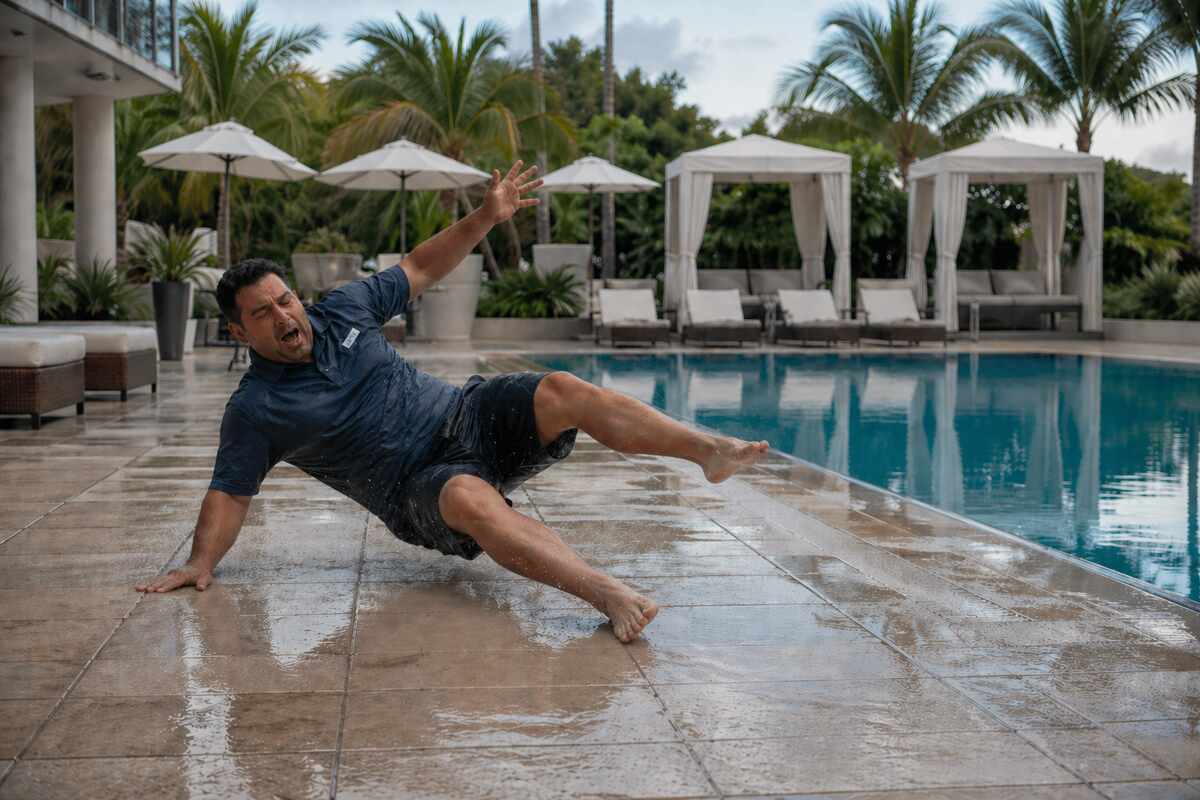
Why Pool Decks Are High-Risk Walking Surfaces (Even When They Look Fine)
Most facilities don’t think their pool deck is a problem. It gets cleaned. It looks fine. It’s been there for years without a major issue. Then someone slips.
That’s usually when the questions start:
“Was this surface ever tested?”
“Do we have anything documented?”
“Has this been an issue before?”
And in most cases, there’s no clear answer. From the surface, pool decks don’t look dangerous. They’re designed for water. They’re built with texture. They’re maintained regularly. But that’s exactly where the risk sits.
Appearance has very little to do with how a surface actually performs.
A floor can look clean, feel textured, and still lose traction under the exact conditions it was built for. If it hasn’t been measured, no one actually knows how it behaves when it matters.
Pool decks combine a few conditions that don’t show up on most walking surfaces:
constant moisture
barefoot traffic
changing environmental factors throughout the day
Individually, those aren’t unusual. Together, they create a surface that can shift from stable to unpredictable without warning. That’s why pool decks aren’t high-risk simply because they’re wet. They’re high-risk because their performance is usually assumed instead of verified.
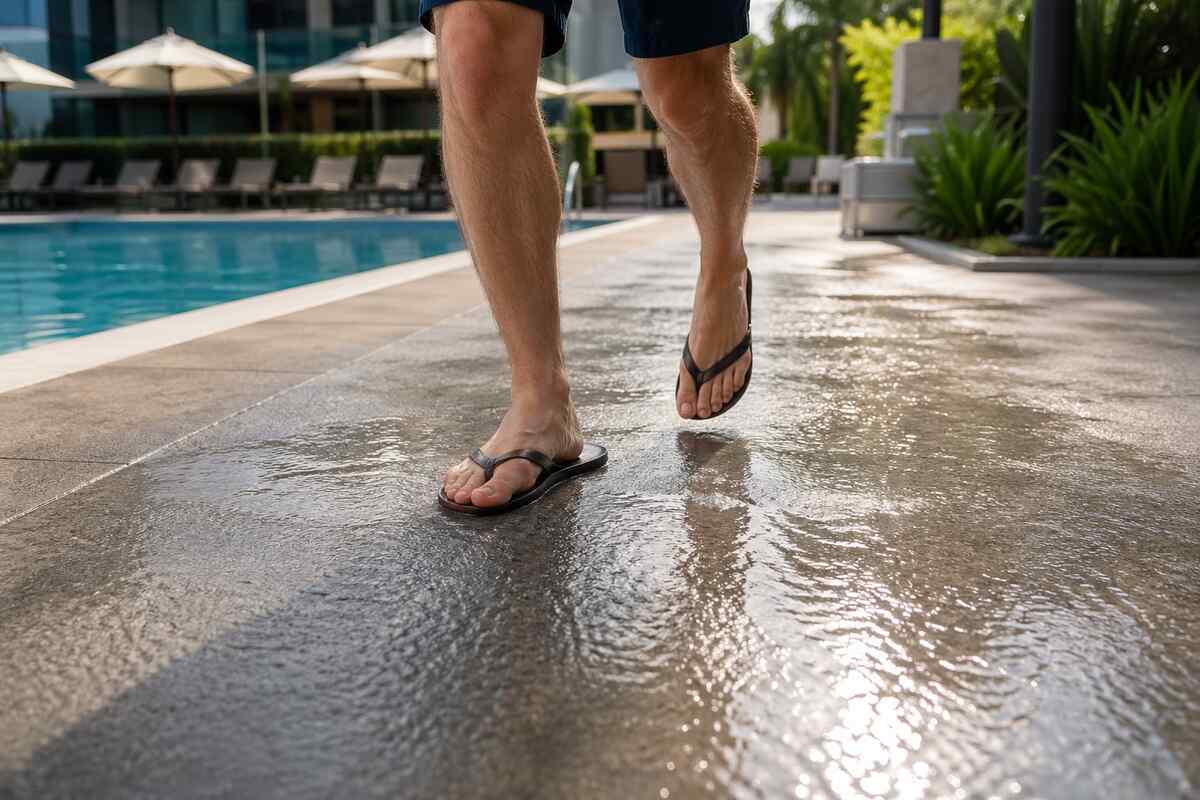
What Makes a Walking Surface “High Risk”?
Before focusing on pool decks specifically, it helps to define what actually makes any walking surface risky. It’s not just water. It’s not just whether someone has fallen before.
A walking surface becomes high risk when its performance is unpredictable and unverified. In regulated environments, surfaces are expected to be maintained in a way that reduces risk, not just visually, but functionally, as outlined in OSHA walking-working surface requirements.
The level of traction changes depending on conditions
The surface behaves differently when wet vs dry
Maintenance or cleaning affects how it performs
No one has measured whether it meets any standard
That last point is where most of the exposure comes from. Because once something happens, the question isn’t:
“Did it look safe?”
The question is:
“Was it evaluated?”
For someone responsible for a facility, that distinction matters. They’re not judged on whether the floor appeared fine during a walkthrough. They’re judged on whether the risk was understood and addressed before the incident.
And that’s where many environments quietly cross into high-risk territory. Nothing looks wrong. No one has raised a concern. There hasn’t been a serious incident yet. But there’s also no baseline. No data. No verification. Which means the surface is operating on an assumption. That’s the real definition of a high-risk walking surface: not obviously dangerous, but not actually understood either.
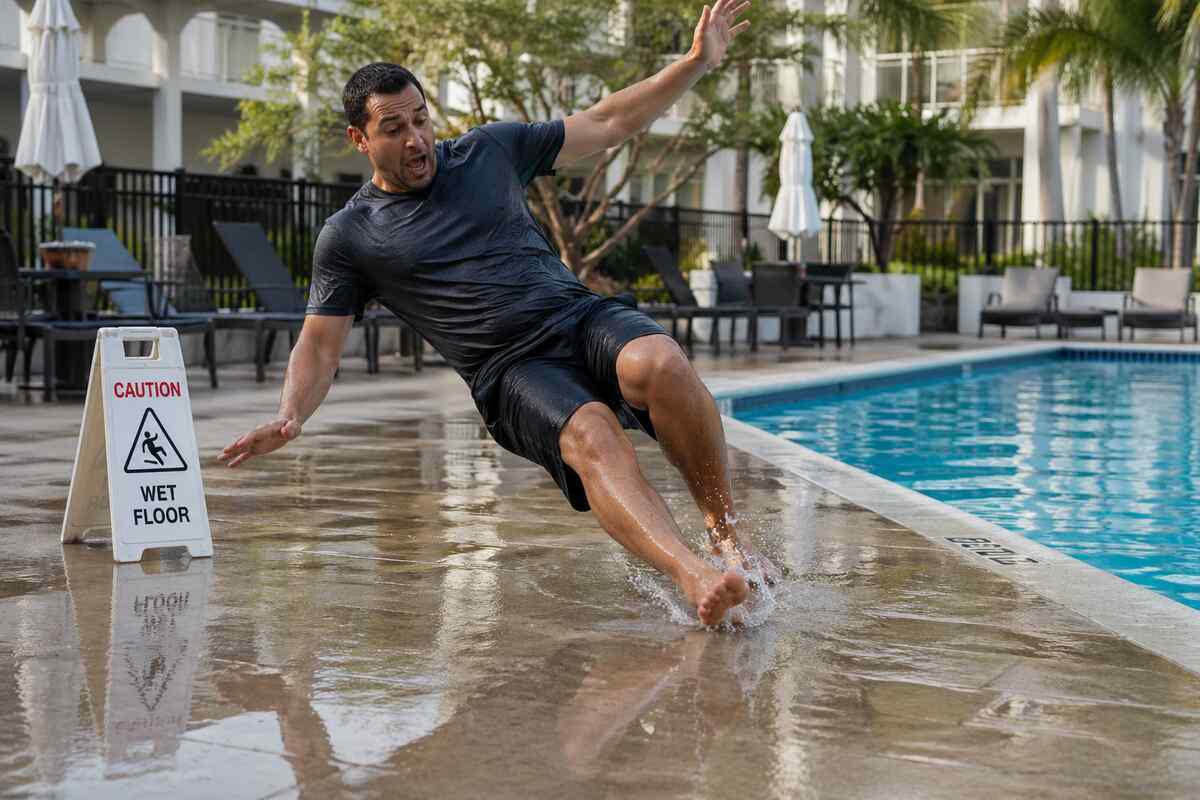
Why Pool Decks Are Inherently High-Risk Environments
Pool decks don’t become risky because of one issue. They become risky because several small variables stack together and change how the surface performs throughout the day. Most of those changes aren’t visible. That’s what makes them easy to overlook.
1. Constant Moisture Changes Surface Behavior
Water is expected around a pool. That’s not the problem. The problem is how the surface responds to it. Some materials maintain traction when wet. Others don’t. And the difference isn’t always obvious by looking at it.
A surface that feels stable when dry can lose enough friction when wet to create a slip risk. That shift can happen quickly, especially in high-traffic areas where water is constantly introduced and redistributed. If that performance hasn’t been tested, it’s an unknown.
2. Barefoot Traffic Changes How People Interact With the Surface
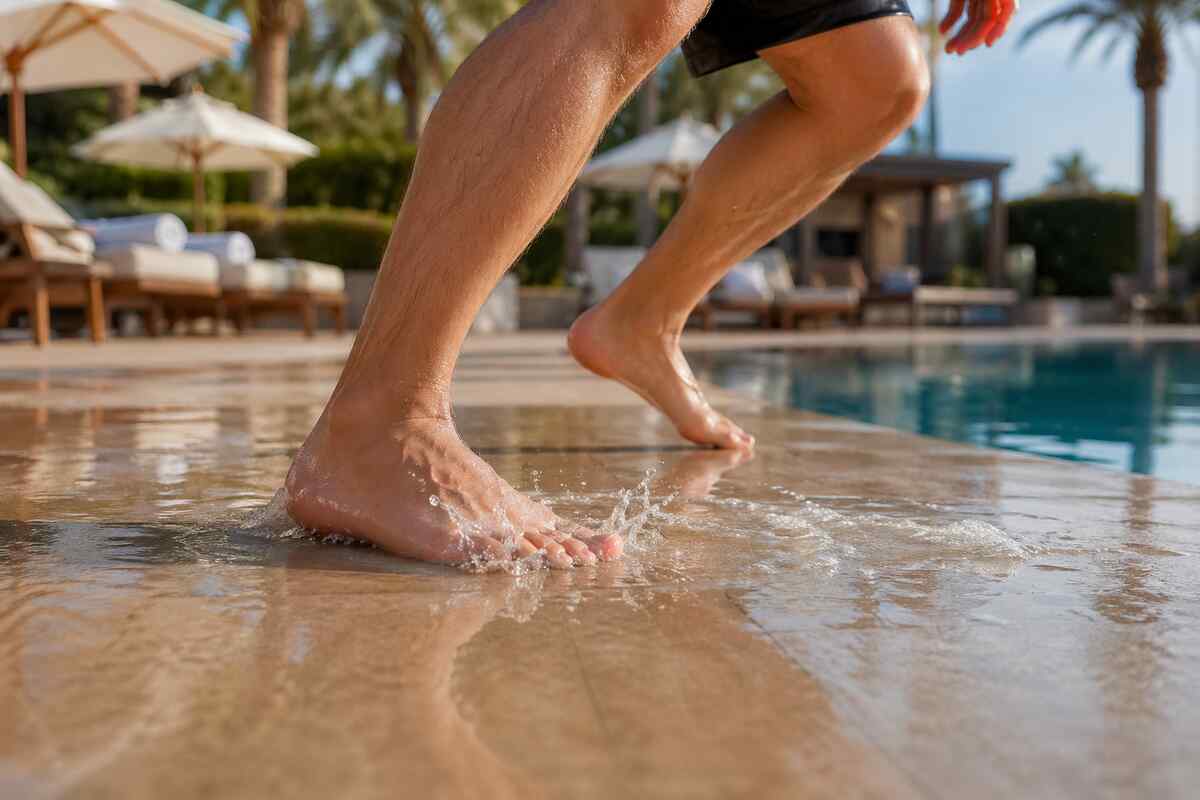
In most facilities, people are wearing footwear designed to provide some level of grip. Around pools, that layer disappears.
Barefoot traffic means:
less stability
more direct contact with the surface
greater sensitivity to small changes in traction
What might be manageable with proper footwear can become a problem without it.
3. Cleaning Practices Often Affect Traction More Than Expected
This is where many issues start. Floors are cleaned regularly, which creates the assumption that safety is improving. In some cases, the opposite happens.
Cleaning can leave residue that reduces traction, alters surface chemistry, and creates inconsistency between shifts or staff. In many cases, the issue isn’t the floor itself; it’s how and why floors become slippery over time.
In facilities with multiple custodial teams, small differences in process can lead to noticeable changes in how the floor performs. The surface didn’t change. The way it was maintained did.
4. Surface Materials Are Chosen for Appearance and Durability
Most pool decks are built using materials like:
concrete
tile
sealed or decorative finishes
These are selected for cost, appearance, and durability. Slip resistance is often assumed rather than verified. A textured finish might look safe. A sealed surface might look uniform and clean. Neither guarantees how the surface performs under wet, real-world conditions.
5. Environmental Factors Add Layers of Variability
Pool environments introduce variables that don’t stay consistent.
Over the course of a day, a surface may be affected by:
humidity
sunscreen and body oils
algae or biofilm buildup
changing temperatures
water flow patterns and drainage
Each of these can slightly alter traction. Together, they create a surface that doesn’t behave the same way hour to hour.
6. Most Pool Decks Are Never Actually Tested
This is the part that ties everything together.
Despite all these variables, most facilities:
don’t measure slip resistance
don’t establish a baseline
rely on visual inspection or past experience
That works until it doesn’t. Because once an incident happens, the focus shifts from what the floor looked like… to whether it was evaluated. Without measurement, there’s no clear answer. And without a clear answer, the surface becomes harder to defend.
The Real Risk Isn’t the Fall — It’s the Exposure
A slip is the event people see. Exposure is what follows. When someone falls on a pool deck, the immediate concern is the injury. That’s understandable. But from a facility standpoint, the bigger issue starts right after.
The questions shift quickly:
Was this surface evaluated?
Is there documentation showing its condition?
Was the risk known and addressed?
If those answers aren’t clear, the situation changes. What could have been a routine incident becomes something that gets reviewed, questioned, and sometimes escalated. This is where many facilities get caught off guard.
Because the environment didn’t feel unsafe. There may not have been a prior incident. Nothing stood out during daily operations. But without a measured baseline, there’s no way to show what the surface actually was at the time. And that matters.
How Risk Escalates in Practice
Slip and fall incidents are a leading cause of workplace injuries, and most of them don’t start as major events.
They build.
The first incident might be minor
The second leads to a report or internal concern
The third is where claims, insurance involvement, or legal review start to appear
At that point, the conversation isn’t about maintenance anymore. It’s about responsibility.
What Gets Evaluated After an Incident
Once an incident is documented, the focus typically shifts to:
Whether the surface met recognized safety expectations
Whether conditions were predictable or preventable
Whether the facility took reasonable steps to evaluate risk
This is where assumptions fall apart. Saying “it looked fine” doesn’t carry much weight.
Saying “it’s always been that way” doesn’t answer the question. What matters is whether the surface was ever actually assessed.
Why Documentation Changes the Outcome
When a surface has been measured and documented, the situation is different.
There’s a record:
what was tested
what the results showed
whether action was needed
That doesn’t eliminate incidents. But it changes how they’re understood. Instead of reacting to a problem after the fact, the facility can show that the surface was evaluated and addressed based on real data.
That’s the difference between:
being surprised by an issue
and being able to explain it clearly
Where Most Facilities Get It Wrong
The pattern is consistent. Most facilities don’t act because something feels off. They act because something already happened. By then, options are more limited.
Costs are higher. Scrutiny is higher. And the conversation is no longer internal.
The better time to evaluate a surface is before any of that starts. Not because every surface is unsafe. But because without testing, it’s still an unknown.
Common Mistakes Facilities Make With Pool Deck Safety
Most pool deck issues don’t come from neglect. They come from reasonable assumptions that turn out to be wrong under real conditions. The problem is, those assumptions usually hold… until they don’t.
Mistake 1: Assuming Texture Means It’s Safe
A surface looks rough, so it must have traction. That’s the assumption.
But texture alone doesn’t tell you how a surface performs when it’s wet, contaminated, or cleaned repeatedly. Two surfaces can look nearly identical and perform very differently under the same conditions. Without testing, texture becomes a visual cue, not a verified property.
Mistake 2: Relying on Mats and Signs to Solve the Problem
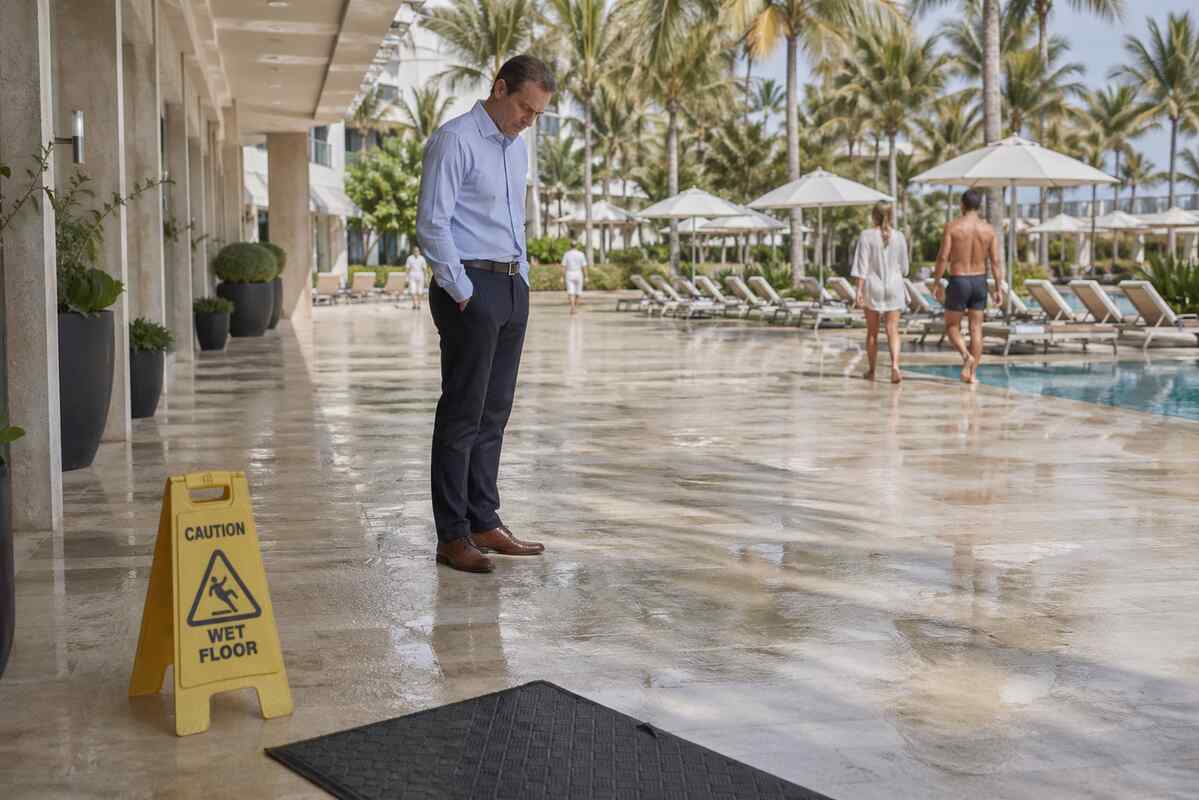
Mats and warning signs have their place. They help manage traffic and signal caution. But they don’t change the surface itself. If the underlying floor lacks traction, the risk is still there. It’s just being managed around, not corrected.
And in many cases, those controls are temporary:
mats shift or wear out
signs get ignored over time
They respond to the hazard. They don’t remove it.
Mistake 3: Applying Coatings Without Knowing If They’re Needed
This is one of the most common reactions after a concern is raised. “Let’s just add something to make it safer.”
Sometimes that helps. Sometimes it creates new problems:
inconsistent appearance
maintenance complications
uneven performance over time
More importantly, it skips the key question: Was there a measurable problem to begin with? If the surface already meets safety expectations, adding a coating doesn’t improve anything. It just introduces another variable.
Mistake 4: Assuming Cleaning Equals Risk Reduction
Cleaning is necessary. But it’s not always neutral. In some cases, it’s the source of the problem.
Small changes in:
chemical selection
dilution ratios
application methods
can affect how the surface performs. And when multiple teams or shifts are involved, consistency becomes difficult. The result is a surface that behaves differently depending on when and how it was cleaned.
Mistake 5: Waiting Until Something Happens
This is the pattern that shows up most often. Nothing feels urgent, so nothing gets evaluated. Then an incident forces the issue.
At that point:
decisions are rushed
solutions are reactive
documentation is missing
The focus shifts from prevention to explanation. And that’s a harder position to manage.
The Pattern Behind All of These
Each of these mistakes comes back to the same issue:
Decisions are being made without a measured baseline. The surface might be fine. It might not be. But without verification, everything in between is guesswork.
How Pool Deck Risk Should Actually Be Evaluated
Most facilities don’t lack effort. They clean regularly. They maintain the space. They respond when something feels off.
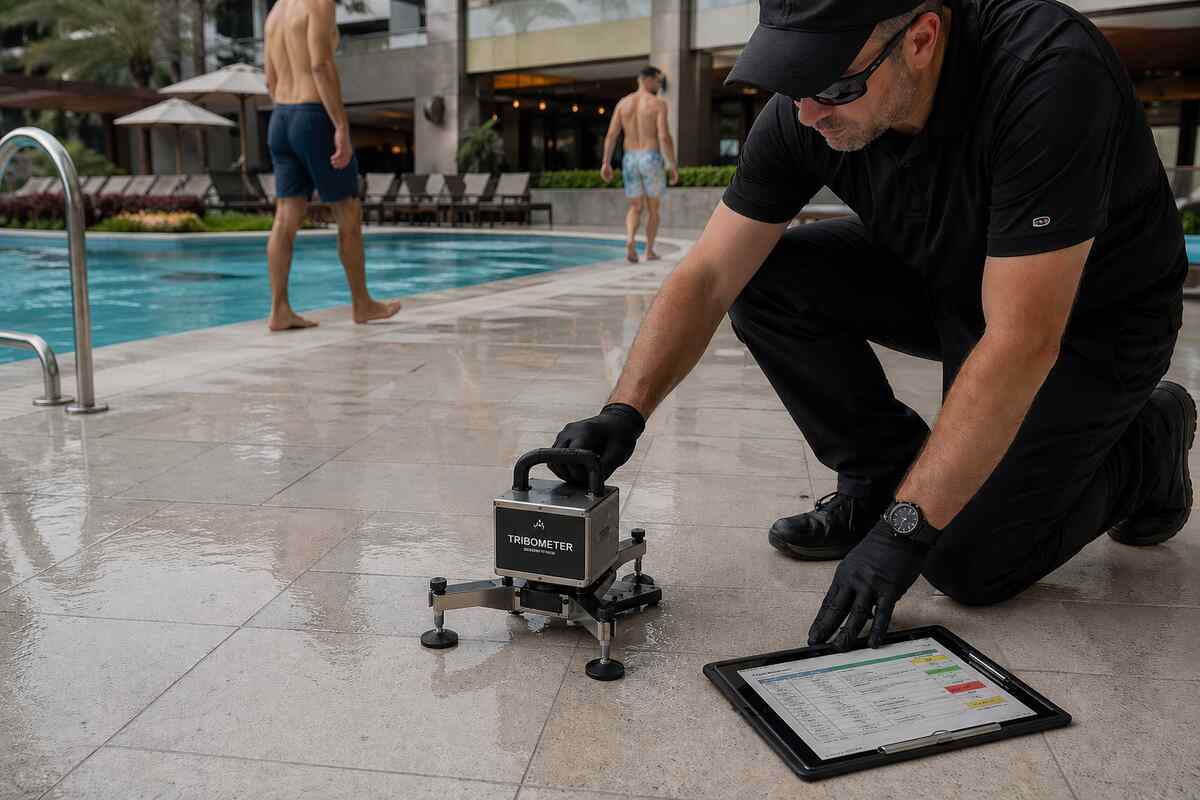
What’s missing is a structured way to determine whether the surface is actually performing safely. Evaluation isn’t about guessing better. It’s about replacing assumptions with something measurable.
Step 1: Establish a Measured Baseline
Everything starts here.
Before changing anything, the surface needs to be evaluated as it currently exists.
That means:
testing how it performs under expected conditions
identifying whether traction meets accepted thresholds
documenting the results
Without this step, every decision that follows is reactive. With it, you have a clear starting point: This is how the surface performs right now.
Step 2: Determine Whether There’s Actually a Problem
Not every pool deck needs treatment. That’s where many approaches go wrong.
If testing shows the surface is already performing within acceptable ranges, the right move may be to:
document the condition
maintain it properly
monitor over time
No alteration. No added materials. No unnecessary cost. This aligns with a simple principle: Only change what actually needs to change.
Step 3: Identify the Root Cause of Any Risk
If the surface does show reduced traction, the next step isn’t immediate treatment. It’s understanding why.
In many cases, the issue isn’t the material itself. It’s something affecting it:
cleaning chemistry or process
residue buildup
environmental factors like moisture control
inconsistent maintenance practices
Correcting these can restore performance without altering the surface. This is often the lowest-disruption, most practical fix.
Step 4: Apply Targeted Intervention Only When Necessary
If the surface still doesn’t meet safety expectations after addressing underlying factors, then intervention makes sense. But it should be intentional and measured.
Options may include:
surface modification to improve traction
coatings where modification isn’t possible
The key is that the decision is based on data, not assumptions. And the goal isn’t to “add safety.” It’s to bring the surface into a range where its performance is known, consistent, and documented.
Step 5: Validate and Document the Outcome
Once changes are made, the process isn’t complete until the results are verified.
That means:
re-testing the surface
confirming performance has improved
documenting the updated condition
This creates a record that can be referenced later if needed. Without this step, improvements exist… but they aren’t proven.
What This Approach Changes
Instead of asking:
“Does this look safe?”
You’re asking:
“Do we know how this performs?”
That shift matters. It moves the conversation from opinion to data. From reaction to control. And for someone responsible for the facility, it replaces uncertainty with something far more useful: a clear, documented understanding of the risk.
What a “Safe” Pool Deck Actually Means
Most people define a safe pool deck by what they can see. It looks clean. It has texture. No one has slipped recently. That feels like safety.
But in practice, those are just observations. They don’t tell you how the surface actually performs under real conditions. A safe pool deck isn’t based on appearance. It’s based on verification.
A Safe Surface Is Measured
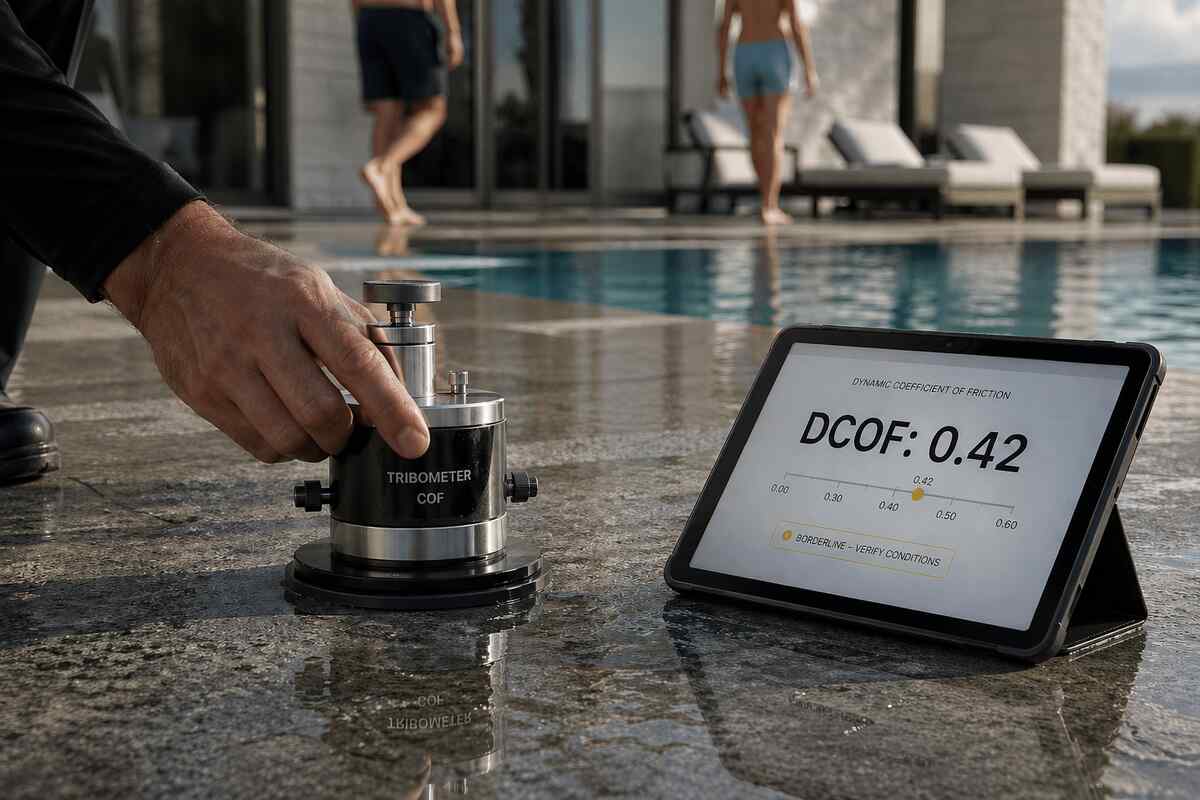
At the most basic level, safety starts with understanding how the surface behaves.
That means:
how much traction it provides
how it performs when wet
whether it stays consistent under normal use
Until that’s measured, everything else is an assumption. Two decks can look identical and perform very differently. Without testing, there’s no way to tell which one is actually safer.
A Safe Surface Is Documented
Knowing how a surface performs is one part of the equation. Being able to prove it is the other.
A documented surface has:
recorded test results
a clear baseline of performance
a reference point for future evaluation
If something changes later, there’s something to compare it to. If something happens, there’s a record that the surface was evaluated. That changes how situations are handled.
A Safe Surface Performs Consistently
Consistency matters more than peak performance.
A surface isn’t truly safe if:
it performs well when dry but fails when wet
it behaves differently depending on cleaning practices
traction varies across different areas
A safe pool deck performs within an acceptable range under the conditions it’s actually used in. Not just during inspection.
A Safe Surface Doesn’t Rely on Assumptions
This is where most definitions fall short.
Many facilities rely on:
past experience
visual checks
the absence of incidents
But none of those confirm how the surface performs today.
Conditions change:
surfaces wear
cleaning methods shift
environmental factors build over time
Without measurement and documentation, safety becomes a moving target.
What Safety Is Not
It’s not:
“It hasn’t been a problem yet”
“It looks like it has grip”
“We added something a few years ago”
Those are all common statements. None of them answers the actual question.
The Practical Definition
A safe pool deck is one that has been:
evaluated under real conditions
shown to meet expected performance levels
documented so the results can be referenced
That doesn’t mean nothing will ever happen. It means the surface is understood. And that changes everything for the person responsible for it.

Has This Pool Deck Ever Been Tested?
Most pool decks aren’t evaluated until there’s a reason to question them. Someone slips. An incident gets reported. Now the surface gets attention. Before that, it usually looks fine. It’s cleaned regularly. It’s been in place for years without a major issue.
But none of that tells you how it actually performs. If it hasn’t been tested, it’s still an assumption. We see this often. A surface is believed to be safe because nothing obvious has gone wrong yet. Then conditions change. Moisture increases. Cleaning methods shift. Traffic patterns vary.
The performance changes with it. And when something does happen, the conversation moves quickly past appearance. It becomes about whether the surface was ever evaluated. Whether there’s anything documented. Whether the risk was understood before the incident.
That’s where most facilities don’t have a clear answer. The better approach is straightforward. Test the surface as it exists. Establish a baseline. Document what it shows. Then decide what, if anything, needs to change.
Sometimes the surface meets expectations, and no treatment is needed. Sometimes there are underlying issues that can be corrected without altering the floor. And sometimes intervention is required to bring the surface into a range where it performs consistently. But that decision should come from measurement, not assumption.
If you’re responsible for a facility, the question isn’t whether your pool deck looks safe. It’s whether you’ve verified how it performs. If you want that answer, you can contact Slip Stoppers of Alabama at 205.473.2925. We’ll test the surface, document the results, and help you determine what actually needs to be done, if anything at all.