
We start with testing.
Most organizations don’t know how their floors actually perform until someone falls and the question gets asked.
Testing before that happens gives you answers instead of explanations.
We start by evaluating the walkways. Not guessing. We measure how the floor performs under real conditions. Then we decide what, if anything, needs to change. That evaluation uses DCOF testing aligned with recognized safety standards, so you’re working from data, not assumptions.
If it hasn’t been tested, no one actually knows how it performs. Our job is to remove that guesswork and give you clear documentation.
Most evaluations and treatments are completed with minimal disruption to daily operations.
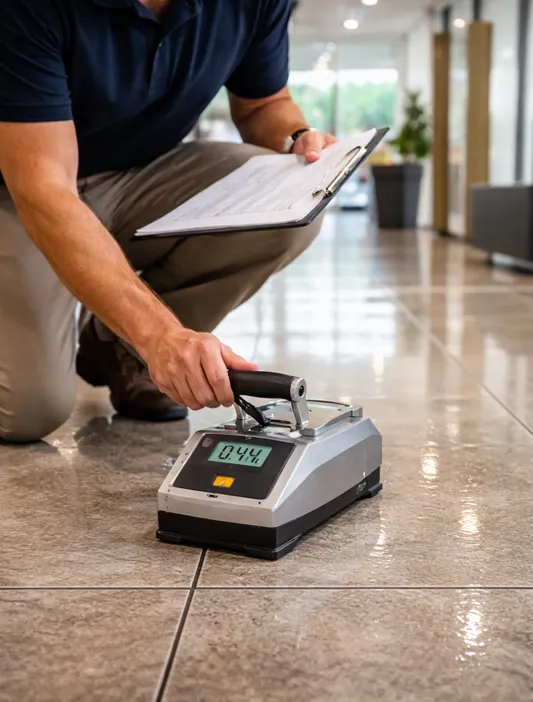
Walkway audits & DCOF testing.
Our walkway audits are built around objective measurement. We come on-site, assess the walking environment, and measure traction using professional DCOF equipment aligned with accepted industry benchmarks.
The result is a measurable baseline of how each area actually performs in real conditions.
We walk the building and test the areas that matter most, especially entries, transitions, and high-traffic zones
We measure traction using DCOF testing so you know how the floor performs under real conditions
We flag areas that are below or close to accepted safety thresholds
You get clear numbers, not opinions
And you receive written documentation showing exactly what was tested and what the results were
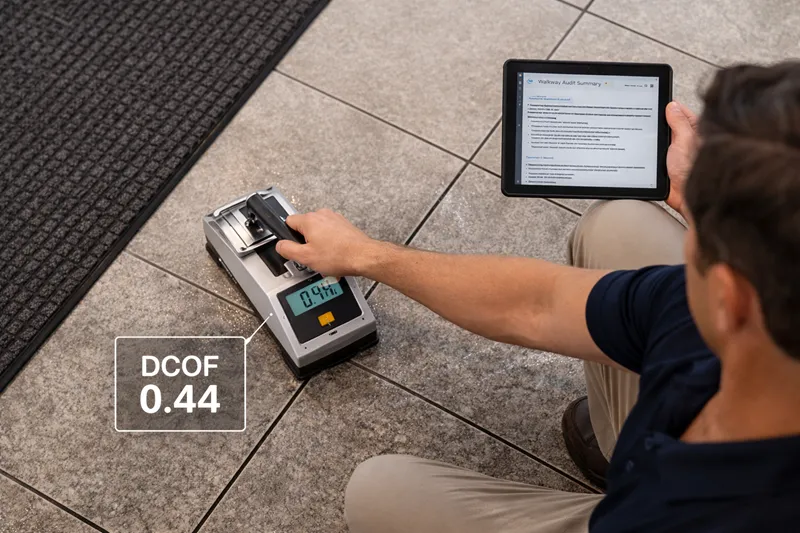
What you take away from an audit.
- Site map or notes of tested areas
- DCOF values by surface and condition
- Summary of areas that meet or fall short of targets
- Practical next steps ranked by priority
Cleaning and maintenance consultation.
Many slip issues start with maintenance, not materials. Chemicals, dilution, tools, and timing all affect how much residue stays on the floor and how the surface behaves when it’s wet.
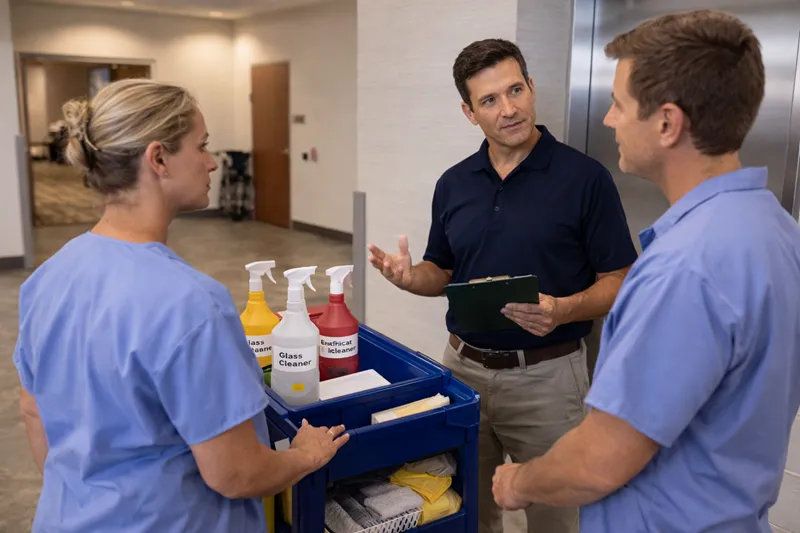
We review your current cleaning products, dilution practices, equipment, and schedules to see whether the system itself is creating a slippery condition.
What we look for.
- Cleaning chemicals that are not suited for the surface or environment
- Incorrect dilution ratios that leave residue behind
- Residue buildup from finishes, degreasers, or disinfectants
- Inconsistent procedures across shifts, teams, or locations
- Areas where moisture and traffic patterns do not match the cleaning plan
Often, the most effective fix is to adjust the chemicals and process, not alter the floor. Education is a core part of lowering slip-and-fall risk over the long term.
Environmental and operational corrections.
Surface traction is only one piece of walkway safety. Moisture, matting, footwear, and workflow all influence real-world slip risk. We look at how people actually move through the space and how water, grease, or contaminants enter and leave the area.
Where it makes sense, we recommend small, targeted changes that reduce risk without disrupting operations.
- Matting selection and placement at entries, transitions, and spill-prone areas
- Moisture control strategies for weather, cleaning, and process water
- Footwear guidance where you can influence shoe selection or policy
- Process and traffic-flow adjustments to separate wet and dry paths
- Signage and temporary controls when conditions cannot be fully engineered out
In many cases, correcting the system around the floor solves the problem without altering the surface.
Where possible, we solve the problem by correcting the environment and processes around the floor. That means less disruption, fewer surprises, and solutions that are easier to maintain over time.
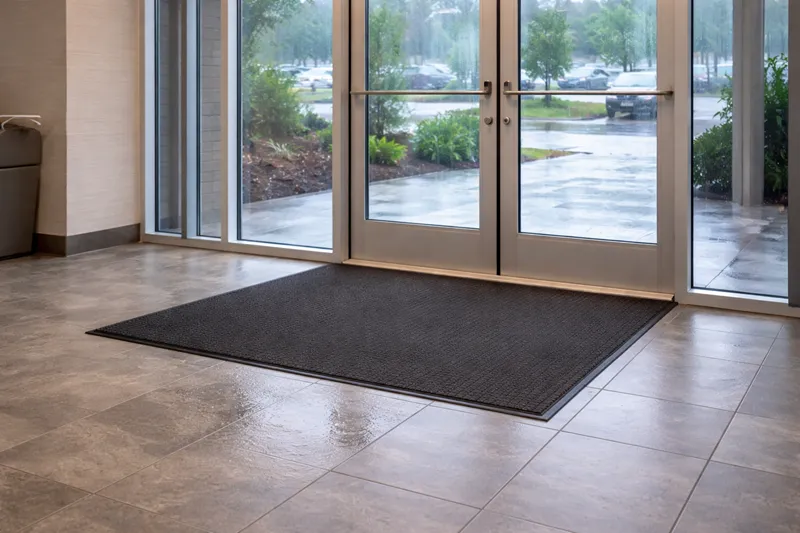
Invisible surface modification.
When DCOF testing shows that a surface does not provide adequate traction, and system corrections are not enough, we look at invisible surface modification first.
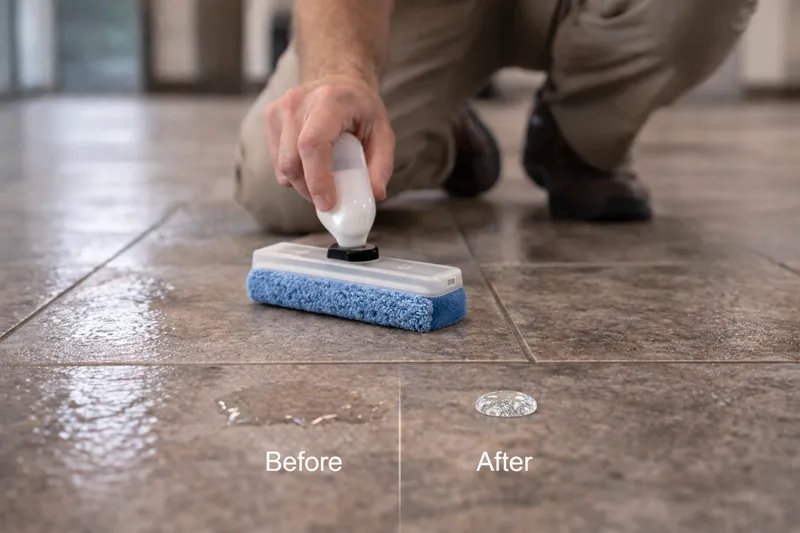
These treatments increase traction while preserving the appearance of the floor. There is nothing to peel, flake, or delaminate, and areas are typically walkable immediately after treatment.
Used when measured DCOF is below recognized safety thresholds
Focuses on changing how the floor performs, not how it looks
No film build; nothing to chip or peel under traffic
Compatible with normal cleaning when procedures are followed
Minimal downtime—areas can generally be returned to service immediately
When we recommend it.
Surface modification is our preferred intervention when testing shows that traction is insufficient and operational or cleaning changes alone cannot close the gap. The goal is to achieve compliant traction with the least visible change and the least disruption.
Anti-slip coatings.
Coatings are reserved for situations where surface modification cannot deliver compliant traction, or where the underlying material requires a coating to meet appropriate standards.
When coatings make sense.
- Surfaces where modification cannot reach the required DCOF values
- Materials that rely on a film build to achieve traction
- Areas with specific visual or branding requirements that rule out other options
- Short-term risk reduction where a longer-term solution is planned
Even then, coatings are applied selectively, guided by test data and the realities of your environment.
How we set expectations.
- Clear reasoning: why a coating is being recommended, backed by test results
- What will change visually and what will remain the same
- Maintenance requirements to keep the coating performing as expected
- How and when to re-evaluate traction as the system wears
- Any tradeoffs between durability, appearance, and traction
Our recommendations are based on measured conditions and clear tradeoffs, not sales pressure.
Post-treatment validation and documentation.
After any intervention—whether system changes, surface modification, or coatings—we re-test. The same DCOF methodology is used to confirm that traction has improved and that results align with your targets.
- Re-testing of treated or adjusted areas using DCOF measurement
- Before-and-after comparison of traction values
- Written documentation summarizing methods and results
- Baseline records you can reference if questions or incidents arise
Thorough documentation supports insurance needs, internal audits, and regulatory or corporate compliance programs. It also shows that decisions were made based on measured conditions, not assumptions.
Documentation review support.
We can also review existing incident reports, floor specifications, and past test data to identify gaps and improve your documentation going forward.
Ongoing walkway management.
Some companies need more than a one-time project. For higher-risk or high-traffic environments, we can establish an ongoing walkway management plan that keeps testing, maintenance, and documentation aligned over time.
- Periodic re-evaluation of key walkways using DCOF testing
- Check-ins to confirm cleaning and maintenance practices remain aligned
- Updates to recommendations as operations or environments change
- Long-term documentation that shows a consistent, data-backed approach
This is about proactive risk management, not constant treatment. We measure before we recommend, every time.
If it hasn’t been tested, it’s still an unknown.
A floor that has never undergone slip resistance testing is an assumption, not a known condition. Our role is to replace assumption with measurement: structured DCOF testing, clear documentation, and practical recommendations only where needed. The priority is clarity over speculation and documentation before intervention.


Professional walkway evaluations aligned with ANSI/NFSI standards. Documentation available for audit, insurance, and risk management review.
Privacy Policy | Terms & Conditions
©2026 Slip Stoppers of Alabama. All rights reserved.
Powered by Kyrios Systems.