
Safety is our profession.
Slip Stoppers of Alabama is owned by certified Walkway Auditor Michael Campbell and Renee Campbell, specializing in measurable walkway safety and standards-based slip resistance evaluation.
Slip Stoppers of Alabama specializes in professional walkway testing and standards-based slip resistance evaluation. We measure before we recommend, using objective slip resistance testing aligned with ANSI/NFSI walkway standards to inform every decision.
We work with facilities across healthcare, hospitality, education, and commercial environments to evaluate how floors actually perform. Every recommendation begins with testing.

Michael Campbell, Owner

Renee Campbell, Owner
Why we do this work.
Slip resistance usually isn’t questioned until after someone gets hurt.
And let's face it...people get hurt.
I’ve seen facilities where floors were assumed safe because they looked fine. Then a fall happens, and suddenly everyone wants to know what the problem was and who to blame.
By that point, the conversation shifts to documentation, exposure, and explanation.
It should never come to that.
-Michael Campbell
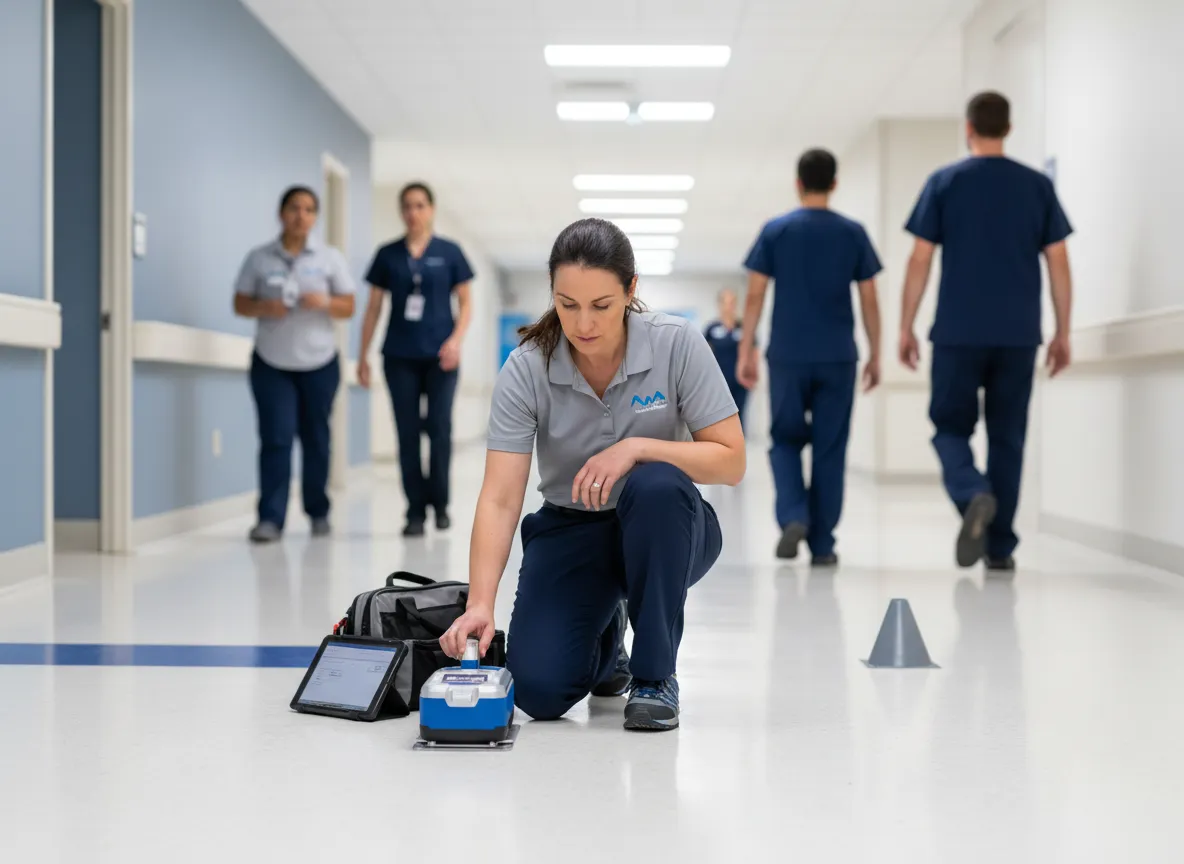
Most floors are never checked.
Most floors are never tested. They’re judged by how they look. Or what the manufacturer brochure said. Or whether anyone has complained.
Appearance doesn’t tell you how a surface performs when it’s wet. That’s what testing is for.
Safety is measurable. Using DCOF testing and other traction measurements, surfaces can be evaluated against recognized ANSI/NFSI walkway standards instead of guessing.
Slip Stoppers of Alabama was built around a measurement-first philosophy. Every walkway audit begins with data: where surfaces meet accepted slip resistance thresholds, that performance is documented. Where they do not, we identify the least invasive way to close the gap.
Measurement-First Principles
- Objective slip resistance testing before any recommendations
- Clear documentation when surfaces meet standards
- Least invasive solutions when improvement is needed
- No coatings or surface changes unless supported by data
Certified in walkway safety evaluation.
Michael Campbell is a professionally trained and certified Walkway Auditor educated in:
ANSI/NFSI walkway safety standards
Dynamic Coefficient of Friction (DCOF) testing
Tribometry and surface traction analysis
Incident investigation and documentation practices
This specialized training is focused specifically on slip-and-fall risk reduction.
How a Walkway Evaluation Is Performed
DCOF testing: Using calibrated instruments to measure Dynamic Coefficient of Friction under defined conditions.
ANSI/NFSI-aligned evaluation: Comparing measured slip resistance to relevant walkway standards and guidance.
Surface traction measurement: Testing representative areas, transitions, and higher-risk walk zones.
Post-treatment validation: Re-testing treated areas to confirm that slip resistance targets have been met.
Documentation protocols: Structured reporting that records locations, conditions, readings, and recommendations.
The outcome is a clear record of where your facility stands today, what changed after any treatment, and how those results relate to slip-and-fall risk reduction efforts.
We’ve seen how this plays out.
In many facilities, slip resistance is questioned only after an incident or near-miss. A fall occurs, and only then do surface conditions, cleaning procedures, and maintenance records come under scrutiny.
When that happens, the conversation immediately shifts to exposure and explanation. Workers’ compensation claims, insurance questions, and potential litigation all depend on what can be shown about walkway safety conditions before the event.
We’ve seen facilities experience multiple falls in a short period of time.
One incident gets attention. Another one raises questions. By the third, insurance and legal teams are involved on a much deeper scale.
At that point, everyone wants to know what had been tested and documented.
Our role is to make sure that question already has an answer.
What Testing Clarifies
- Which walkways meet slip resistance expectations.
- Where conditions fall below target thresholds.
- How cleaning products and procedures affect traction.
- What was known and documented before an incident.
We don’t start with coatings.
We start with testing. If your floor already meets standards, we document it and leave it alone. If cleaning procedures are affecting traction, we fix that first. Only when measurements show a real gap do we recommend surface modification or coatings.
1. Measure and Document
Perform a structured walkway audit, including DCOF and traction testing, and record baseline slip resistance readings with locations and conditions.
2. Correct Systems First
Review cleaning products, dilution, tools, and schedules. Many slip resistance issues can be improved through procedural and chemistry changes alone.
3. Modify Surfaces When Needed
If measurements remain below target after system corrections, we consider mechanical or chemical modifications appropriate to the surface type and operational needs.
4. Use Coatings Only When Required
Coatings or topical treatments are considered only when data shows they are necessary and appropriate. Sometimes the correct recommendation is documentation only; sometimes it is a cleaning change. The solution follows the measurements, not sales targets.
You can’t shut down your business to experiment with safety.
Hospitals still have patients. Hotels still have guests. Businesses still have traffic. Evaluations and treatments are planned around that reality.
Evaluations are scheduled around operations—off-hours, low-traffic windows, or in coordinated zones—so that testing and any treatments minimize disruption. Most products and processes used for slip-and-fall risk reduction are walkable quickly, with clear communication on cure times and re-entry.
Documentation is structured so it can be used in audits, insurance renewals, and internal safety reviews. You receive clear records of where testing occurred, what was found, and what was done—information designed to support your role, not add noise to it.
Designed for Real Operations
- Scheduling aligned with patient care, guest flow, and production schedules.
- Clear communication about timing, access needs, and any short closures.
- Most treatments walkable quickly, with defined return-to-service timelines.
- Reporting formatted for safety committees, risk management, and compliance teams.
The goal is simple: improve walkway safety without creating new operational headaches.
If it hasn’t been tested, it’s still an unknown.
A floor that has never undergone slip resistance testing is an assumption, not a known condition. Our role is to replace assumption with measurement: structured DCOF testing, clear documentation, and practical recommendations only where needed. The priority is clarity over speculation and documentation before intervention.


Professional walkway evaluations aligned with ANSI/NFSI standards. Documentation available for audit, insurance, and risk management review.
Privacy Policy | Terms & Conditions
©2026 Slip Stoppers of Alabama. All rights reserved.
Powered by Kyrios Systems.