
Walkway Testing Authority
Why Testing Matters
Most slip-and-fall decisions are made based on how a floor looks. Traction is not about appearance. It’s about performance under real conditions.
If a floor hasn’t been measured, its slip resistance is an assumption. DCOF testing replaces assumption with data you can explain, document, and act on.
A brief, non-disruptive walkway audit can establish current floor traction and identify where slip resistance testing adds the most value.
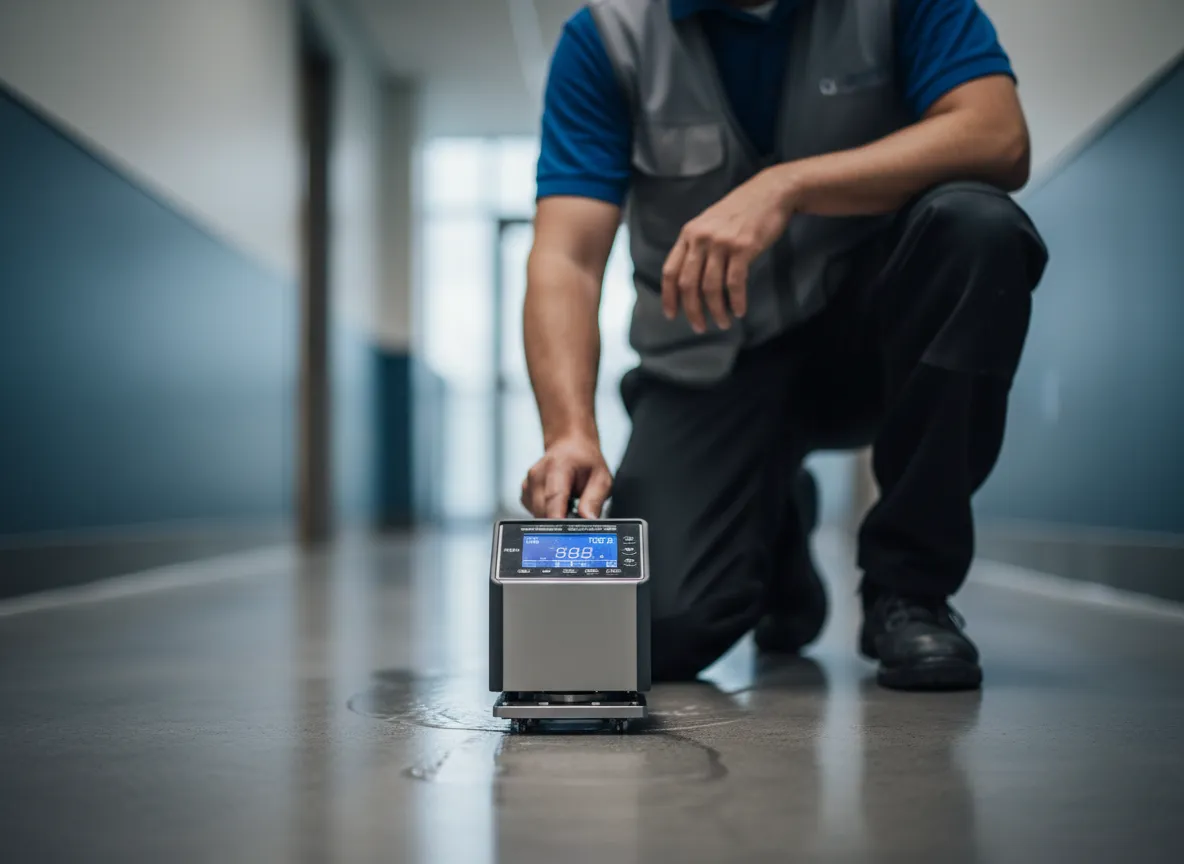
What you’re seeing: A DCOF meter measuring dynamic coefficient of friction on a walkway surface under controlled, repeatable conditions.
This kind of slip resistance testing moves the conversation from “the floor looked fine” to “here is how the floor actually performed.”
What does DCOF tell you?
DCOF stands for Dynamic Coefficient of Friction. In simple terms, it is a way to quantify how much traction exists between a moving foot and a floor. Instead of guessing based on appearance, DCOF testing gives you a numeric value that can be compared against accepted safety thresholds.
- It measures how much resistance there is to sliding when a foot (or test slider) is already in motion.
- It simulates how a person’s shoe interacts with the surface while walking, not just standing still.
- It produces a repeatable, numeric result instead of a “looks okay” judgment.
- It lets you compare different areas, products, or changes in cleaning chemistry over time.
A floor can look clean, polished, and professionally maintained and still test below commonly referenced safety levels in ANSI and NFSI walkway safety standards. Without a measured baseline, it is difficult to show that a surface is performing as intended.
Slip resistance testing using ANSI/NFSI-recognized methods gives you that baseline. From there, you can make informed decisions about cleaning processes, surface treatments, or where additional controls are needed.
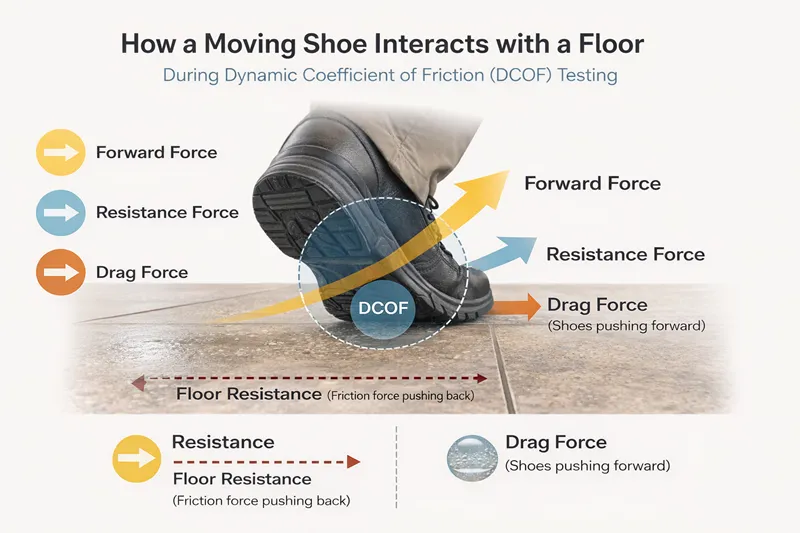
Diagram: How a moving shoe interacts with a floor during dynamic coefficient of friction testing.
DCOF compares two forces: how strongly the floor pushes back versus how strongly something is trying to slide across it.
The result is a dimensionless number (for example, 0.35 or 0.45) that can be compared to ANSI/NFSI walkway safety guidance.
A floor can look fine and still be risky.
Most facility teams rely on visual cues: shine, cleanliness, scuffing, or how “new” a floor looks. Unfortunately, slip resistance does not follow those visual rules.
- Gloss does not equal traction. High-shine finishes can test either safe or unsafe, depending on how they interact with moisture and footwear.
- Residue from cleaning products can lower slip resistance even when the floor looks freshly cleaned.
- Improper dilution of detergents or finishes can leave a thin film that changes how shoes behave on the surface.
- Moisture—from weather, mopping, condensation, or spills—can dramatically change performance, especially on smooth materials.
- Environmental factors like slope, transitions, and traffic patterns all influence real-world slip-and-fall risk.
The key idea: slip resistance cannot be judged visually. Intuition is helpful for spotting obvious issues, but it is not a measurement. DCOF and other slip resistance testing methods turn those assumptions into verifiable data.
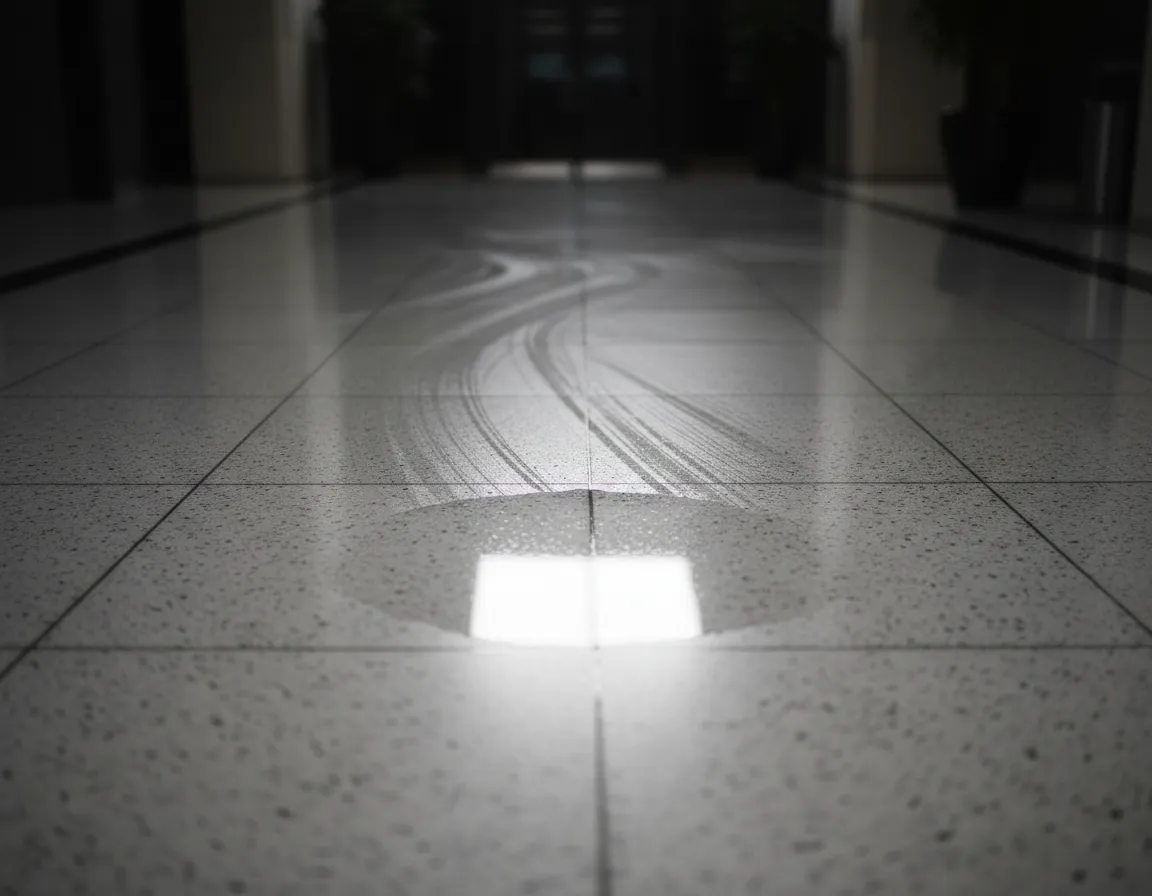
What you see: Clean, glossy, recently mopped entry floor.
Visually, this might be judged as “safe” based on housekeeping standards alone.
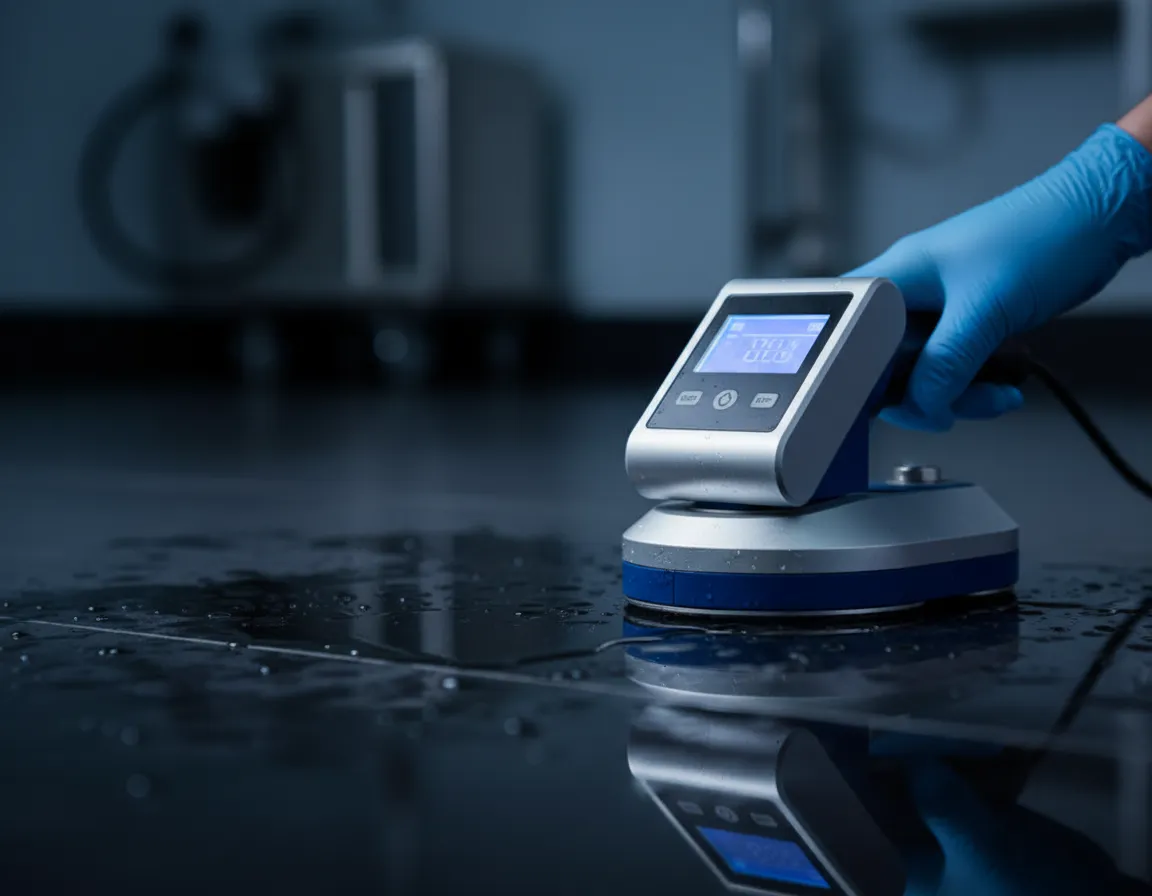
What is measured: DCOF reading showing how the floor actually performs under wet, dynamic conditions.
Here, slip resistance testing might reveal values below internal or walkway safety targets—despite ideal housekeeping.
Signs and mats do not change surface traction.
Warning signs and entry mats are important parts of a safety program. They communicate risk and help manage moisture. But they do not change how the floor itself behaves when someone walks on it.
- Wet floor signs warn. They do not increase friction or change the DCOF of the surface.
- Entry mats help capture water and debris, but do not correct low slip resistance on surrounding flooring.
- Cones, barriers, and temporary controls are valuable management tools, not permanent engineering controls.
- If the same wet, low-traction surface remains in service, the underlying slip-and-fall risk also remains.
Testing focuses on the surface itself. By measuring floor traction with DCOF testing or other standardized slip resistance testing methods, you can decide where signs and mats are sufficient and where surface performance needs to be improved.
The goal is not to replace standard safety practices, but to pair them with verified data so your program addresses both communication and underlying surface performance.
Controls that work together
- Administrative controls: policies, training, wet floor signs, response procedures.
- Physical controls: mats, drains, canopies, walk-off zones.
- Surface performance: verified slip resistance through DCOF and related testing.
When documentation shows that surface traction has been measured—and that signs and mats are being used appropriately—your walkway safety program is easier to explain and defend.

Documentation does not eliminate risk, but it clearly shows due diligence. For healthcare, hospitality, retail, and other public-facing environments, that clarity is often as important as the technical numbers themselves.
If something happens, documentation is what matters.
In any slip-and-fall claim or internal review, two questions usually come up:
- What was the condition of the floor at the time?
- What did the organization do to understand and manage that condition?
Measured data from DCOF testing and other ANSI/NFSI walkway safety standard methods allows you to answer both, calmly and specifically.
- Baseline records show that a walkway audit or slip resistance testing was completed before any incident.
- Documented readings, locations, and conditions show that traction was evaluated against internal or industry targets.
- Follow-up testing provides evidence that corrective actions—such as cleaning changes or surface treatments—were measured for effectiveness.
- Periodic re-testing demonstrates that monitoring is ongoing, not one-time.
When should a floor be tested?
For most organizations, slip resistance testing becomes part of normal facility planning—not just a response to a problem. The following triggers are practical times to measure DCOF and related traction values.
After installation
New flooring, coatings, or finishes should be tested once they are in service. This confirms that the as-installed surface meets your slip resistance targets before heavy traffic begins.
After a slip incident
If a slip-and-fall occurs, testing provides objective information about the floor’s condition rather than relying only on memory and perception. It also helps guide whether broader testing is needed in similar areas.
After chemical changes
Switches in cleaning products, dilution ratios, or floor finishes can change DCOF values—sometimes in ways that are not visible. A quick slip resistance test verifies that the new approach maintains or improves traction.
High-traffic and wet-prone areas
Entrances, ramps, restrooms, food service areas, pool decks, and healthcare corridors experience more moisture and more foot traffic. Regular slip resistance testing in these zones provides an early warning if conditions start to change.
Proactive risk management
Many organizations now treat DCOF testing and broader walkway audits as part of an annual or biannual safety review. This aligns slip resistance with other routine checks—sprinklers, life safety systems, and clinical environment-of-care rounds—rather than waiting for an incident to prompt action.
If it hasn’t been tested, it’s still an unknown.
A floor that has never undergone slip resistance testing is an assumption, not a known condition. Our role is to replace assumption with measurement: structured DCOF testing, clear documentation, and practical recommendations only where needed. The priority is clarity over speculation and documentation before intervention.


Professional walkway evaluations aligned with ANSI/NFSI standards. Documentation available for audit, insurance, and risk management review.
Privacy Policy | Terms & Conditions
©2026 Slip Stoppers of Alabama. All rights reserved.
Powered by Kyrios Systems.