
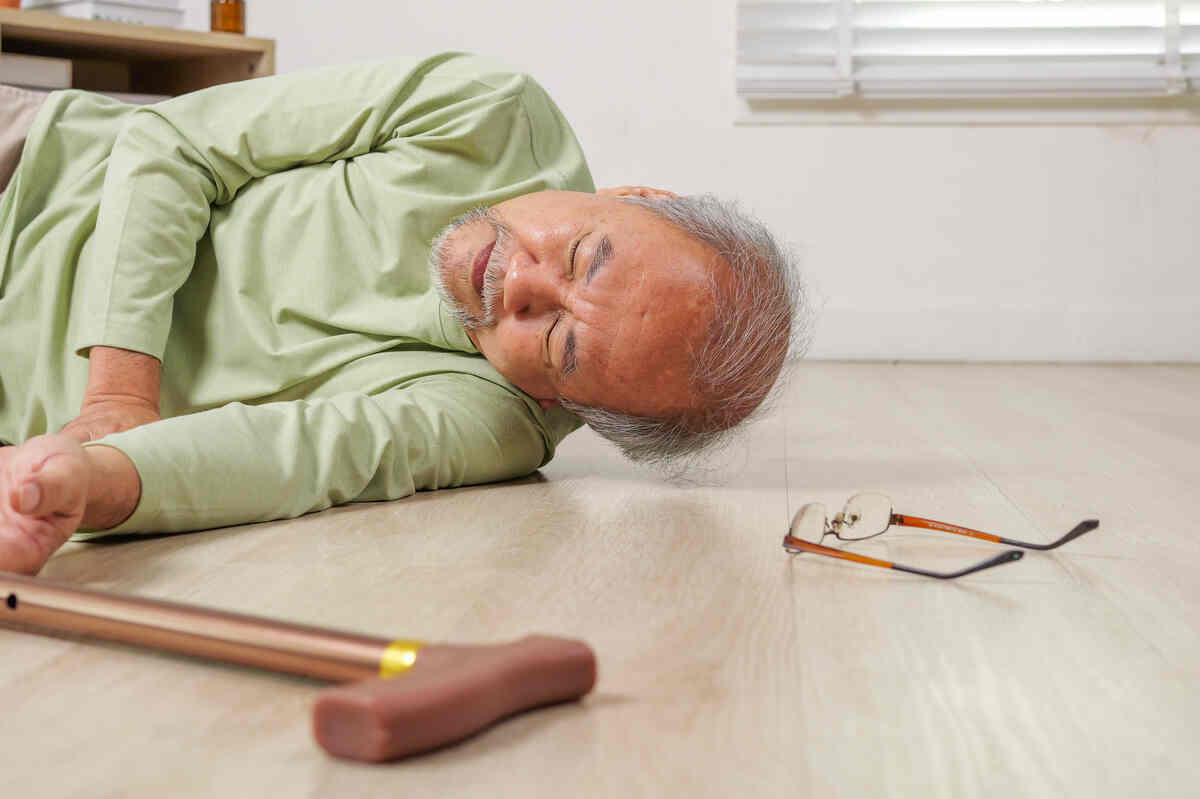
The Real Causes Behind Most Slip-and-Fall Accidents
Most slip-and-fall discussions start with what people can see — water on the floor, a spill, uneven tile. But those are just conditions. They don’t explain why someone actually loses their footing.
A slip happens when there isn’t enough traction between the shoe and the walking surface. When that grip drops below a certain point, the foot can’t hold, and balance is lost. Everything else — water, dust, cleaning residue — only matters because it affects that traction.
This is where things get misunderstood. A floor doesn’t have to look dangerous to be unsafe. It just has to behave differently under certain conditions.
For example, a surface might feel completely stable when it’s dry. The same surface, after mopping or during rain, can behave very differently. Nothing about it looks worse. But the friction has changed, and that’s enough.
That’s why slips often seem random. Someone walks the same path every day without an issue, then suddenly there’s an incident. From the outside, it doesn’t make sense. But from a performance standpoint, something changed — moisture, residue, or even cleaning method — and the surface crossed a threshold.
Most floors don’t fail all the time. They fail under the right conditions.
Once you look at it this way, the focus shifts. It’s not just about spotting hazards. It’s about understanding how a surface performs when those conditions show up — because they always do.
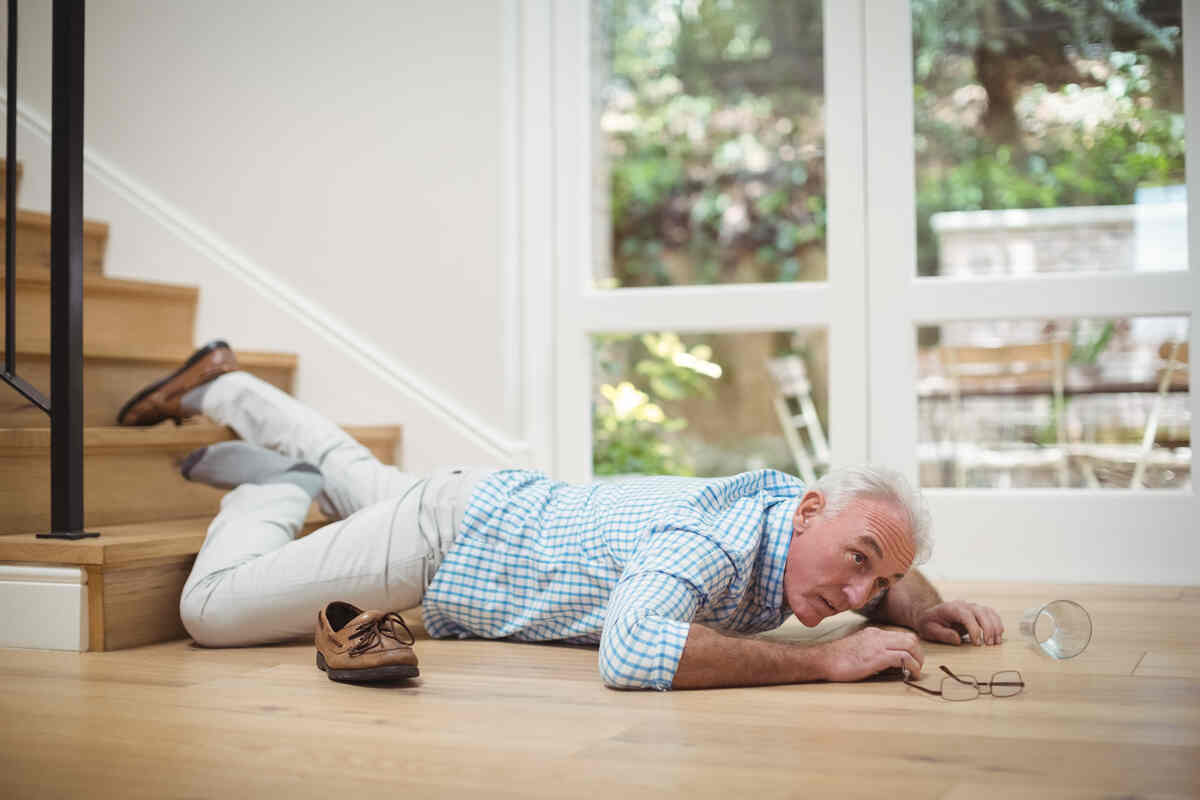
The Most Common Slip-and-Fall Hazards
When people talk about the most common slip and fall hazards, the list is usually predictable. Wet floors, uneven surfaces, spills, poor lighting, weather-related moisture — all valid, all real.
But this is where most explanations stop short.
These hazards are easy to recognize because they’re visible. You can see water. You can notice a surface change. You can point to the condition and say, “That’s the problem.” But in practice, those conditions don’t always lead to incidents.
A wet floor doesn’t automatically mean someone will slip. An uneven surface doesn’t always cause a fall. These situations only become dangerous when the surface can’t maintain traction under those conditions.
That distinction matters.
Two entrances can both be wet from rain. One has people walking through all day without issue. The other becomes a problem within minutes. From a distance, they look the same. What’s different is how the surface performs when moisture is introduced.
The same pattern shows up with cleaning. A floor can be freshly cleaned and look better than it did before, yet feel more slippery underfoot. Nothing about it appears unsafe, but the condition of the surface has changed in a way that reduces traction.
This is why focusing only on hazards can be misleading. It keeps attention on what’s visible instead of what’s measurable.
The hazard doesn’t cause the fall by itself. It reveals whether the surface was capable of handling that condition in the first place.
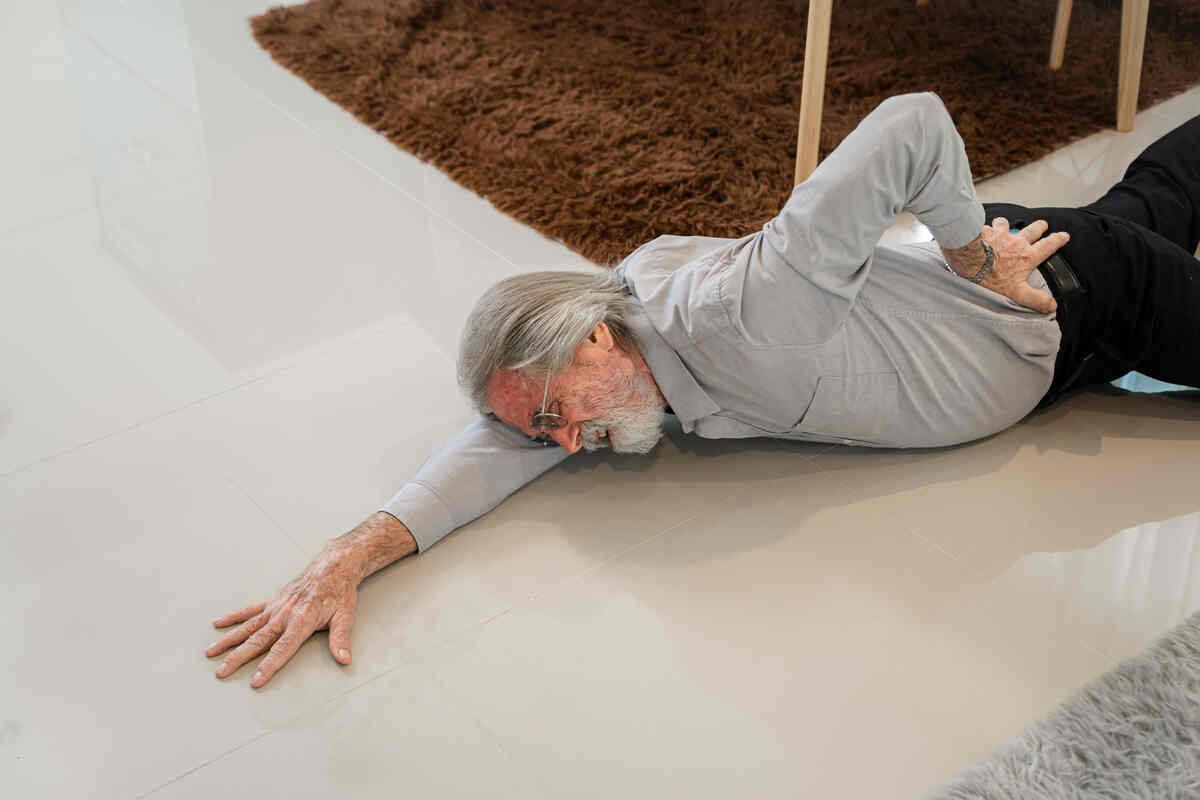
The Real Causes of Slip and Fall Accidents
Once you move past visible hazards, the causes of slip and fall accidents become more consistent — and more controllable.
In most facilities, incidents don’t come from a single obvious failure. They come from a combination of conditions interacting with a surface that hasn’t been fully understood. When you break it down, the same root causes show up again and again.
Lack of Measured Traction
Most floors are never tested. They’re installed, cleaned, maintained, and assumed to be safe unless something proves otherwise.
That assumption is where the problem starts.
A surface might meet accepted safety thresholds, or it might fall short. Without measurement, there’s no way to confirm either. Everything is based on appearance or past experience, neither of which tells you how the floor actually performs.
This creates a situation where risk exists quietly in the background until it’s exposed.
Cleaning Practices That Reduce Slip Resistance
Cleaning is one of the most overlooked causes of slip issues.
It’s common to assume that if a floor is clean, it’s safer. In reality, cleaning can change how a surface behaves — sometimes in ways that reduce traction.
This usually comes down to process:
Using the wrong chemical for the surface
Improper dilution
Residue left behind after mopping
Inconsistent methods between staff or shifts
Over time, these small variations add up. A floor that once performed well can gradually become more slippery, especially when moisture is introduced.
Many facilities first notice a problem not when the floor is dirty, but right after it’s been cleaned.
Moisture Without Control Systems
Water is predictable. Rain happens. Spills happen. Mopping is part of routine maintenance.
The issue isn’t the presence of moisture. It’s how it’s managed.
Entrances are a common example. During wet weather, water gets tracked inside and spreads across walking paths. If there’s no structured matting system or moisture control strategy, conditions change quickly and unevenly.
Some areas dry faster than others. Some retain moisture longer. That inconsistency increases the chance that someone encounters a surface that doesn’t provide enough traction.
Flooring Materials That Change Under Real Conditions
Not all flooring behaves the same way, especially when conditions shift.
Certain materials — like tile, polished concrete, or natural stone — often perform well when dry but lose traction when wet or contaminated. These materials are often selected for durability or appearance, not necessarily for how they perform in every condition.
This creates a gap. The floor meets expectations visually and functionally most of the time, but under the right conditions, its performance drops below what’s considered safe.
Inconsistent Maintenance and Oversight
In many facilities, floor care isn’t as standardized as it appears.
Different team members may follow slightly different procedures. Vendors may rotate in and out. Over time, processes drift without anyone formally tracking those changes.
The result is inconsistency.
Even small differences in cleaning methods, timing, or materials can affect how a surface performs. Without a consistent system — and without verification — those changes go unnoticed until they lead to an incident.
Overreliance on Temporary Fixes
When a risk becomes visible, the response is often immediate but short-term.
A sign goes up. A mat gets placed. A specific area gets extra attention.
These actions can help in the moment, but they don’t resolve the underlying condition of the surface. They also don’t provide any record that the issue was evaluated properly.
If the same conditions show up again, the same risk is still there.
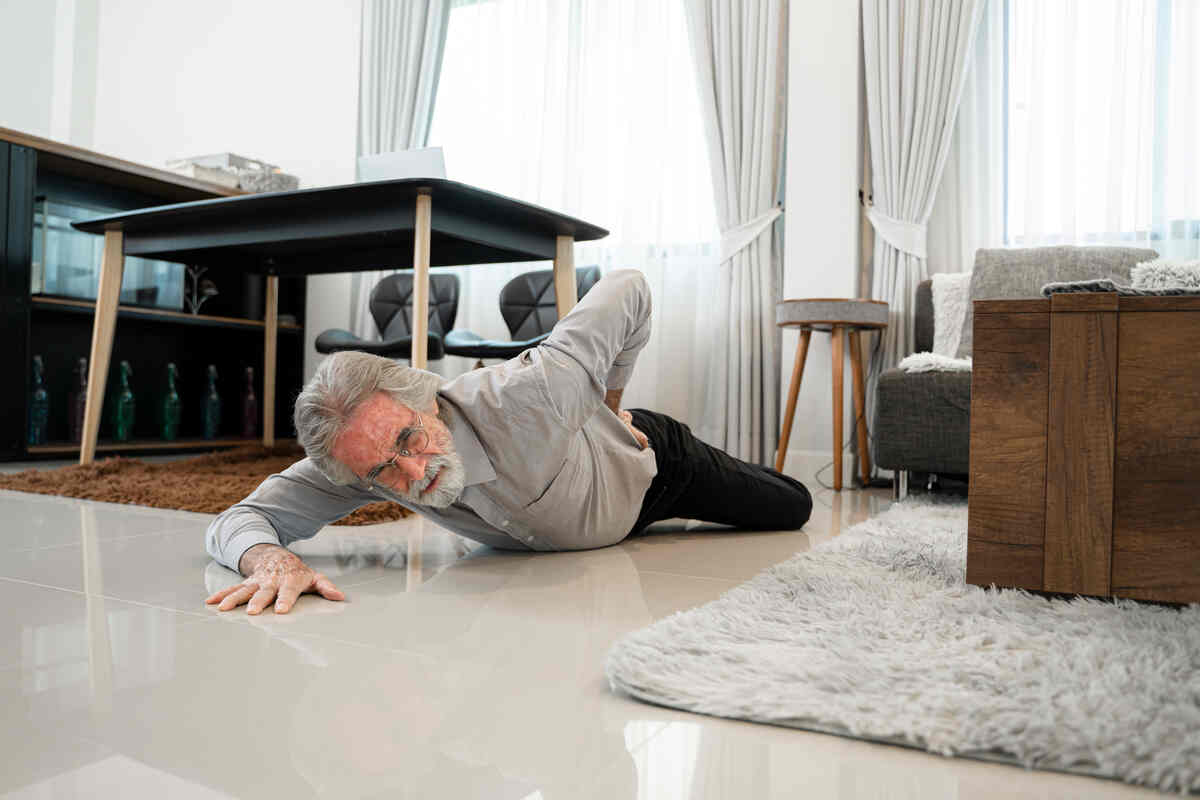
Slip and Fall Risk Factors That Increase Exposure
Most slip incidents aren’t caused by a single issue. They happen when multiple factors overlap at the same time.
A floor might perform well under normal conditions, but when you layer in moisture, cleaning residue, foot traffic, and timing, the margin for error gets smaller. That’s when exposure increases.
It’s more accurate to think in terms of slip and fall risk factors rather than isolated causes. These factors tend to fall into a few consistent categories.
Environmental Risk Factors
These are the conditions that change how a surface behaves.
Moisture is the most common — rain at entrances, spills, humidity, or routine mopping. Contaminants like dust, oils, or debris also fall into this category.
These factors are often predictable. Weather patterns, cleaning schedules, and traffic flow don’t change randomly. But they’re not always managed as part of a system, which is where problems start to build.
Operational Risk Factors
This is where day-to-day processes come into play.
Cleaning methods, chemical use, dilution ratios, and maintenance schedules all affect how a surface performs. Even small inconsistencies can shift traction over time.
In many facilities, these processes exist, but they’re not always standardized or verified. That creates variation — and variation leads to unpredictability.
Human Factors
People move differently depending on the environment.
Footwear, pace, distractions, and familiarity with the space all influence how someone interacts with a surface. In high-traffic areas, especially, people aren’t walking cautiously. They’re moving with purpose.
A surface that requires “careful walking” to be safe is already operating too close to the edge.
System-Level Gaps
This is where the biggest exposure usually exists.
Many organizations don’t have:
A measured baseline of floor performance
Documentation showing that surfaces were evaluated
A clear understanding of how conditions affect traction
Without these, decisions are based on assumptions. And when something happens, there’s no record showing the risk was assessed ahead of time.
When these factors overlap — moisture on a surface affected by cleaning residue, during a high-traffic period, without a verified baseline — the likelihood of an incident increases quickly.
The key point is this: risk builds in layers. It’s rarely one thing.
Workplace Slip and Fall Causes (Why Facilities Are Especially Exposed)
Slip incidents in workplaces tend to follow the same patterns, but the environment makes them harder to control.
In a commercial or institutional facility, you’re not dealing with one surface or one set of conditions. You’re managing a system — multiple materials, changing traffic, cleaning cycles, and constant environmental shifts. That complexity is what increases exposure.
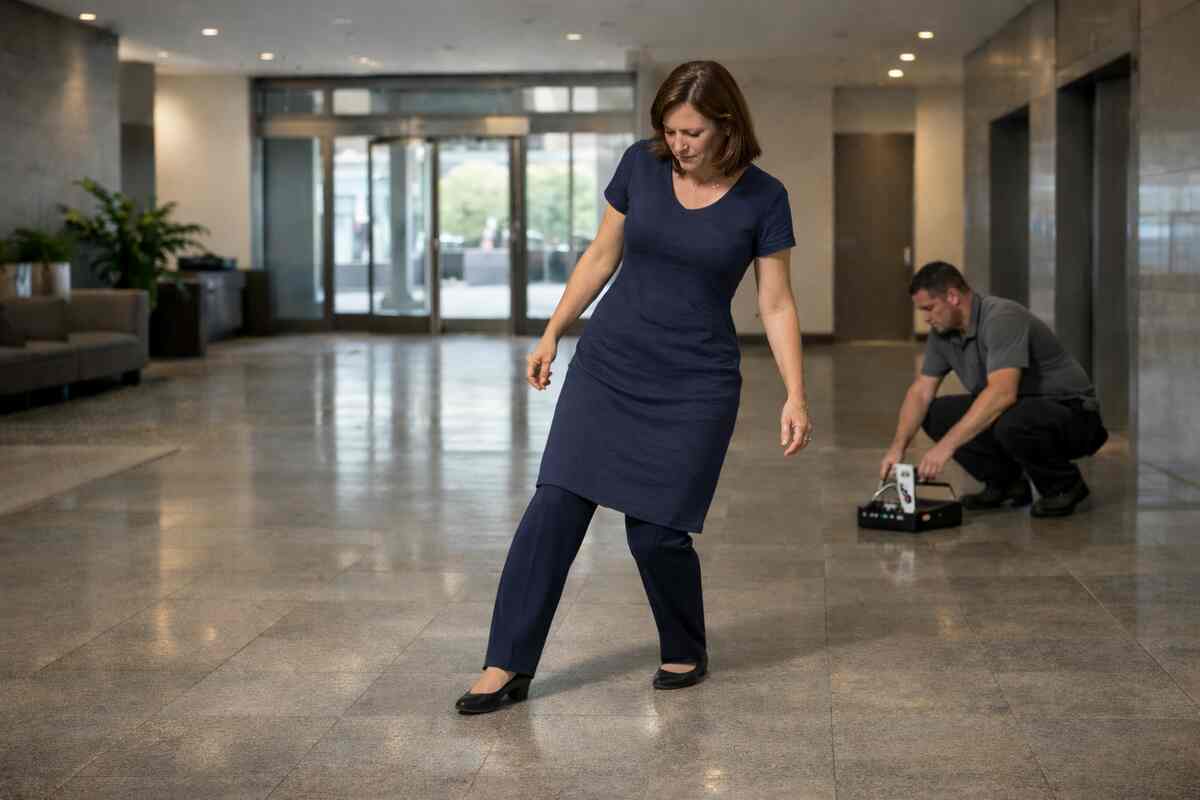
One of the biggest factors is traffic variability. The same hallway can be low-traffic in the morning and heavily used an hour later. Entrances, restrooms, and transition areas see constant movement, often when conditions are changing at the same time. People aren’t walking cautiously. They’re moving with purpose, carrying items, or focused on something else.
Cleaning adds another layer. Floors are often maintained on a schedule that doesn’t always align with usage. A surface might be mopped just before peak traffic, or cleaned in sections while people are still moving through the space. That creates moments where conditions shift quickly, but the environment hasn’t adapted.
There’s also the issue of mixed surfaces. Many facilities transition between tile, concrete, vinyl, or stone within the same path of travel. Each material behaves differently, especially when moisture or residue is involved. To the person walking, it feels like one continuous space. In reality, the performance can change from one step to the next.
Then there’s the expectation of documentation and accountability.
In a workplace, especially at the facility level, the question isn’t just “Was the floor safe?” It’s:
Was it evaluated?
Was there a known baseline?
Can that be shown after the fact?
That’s where many organizations feel exposed. An incident doesn’t just trigger cleanup. It triggers questions about what was known beforehand and whether the risk was addressed properly.
This is why workplace slip and falls are less about isolated hazards and more about how systems are managed. When conditions, processes, and surfaces aren’t aligned, small gaps turn into real risks.
Why Most Prevention Advice Falls Short
Most advice around slip prevention sounds reasonable on the surface.
Use mats.
Put up caution signs.
Clean more frequently.
None of that is wrong. But it doesn’t go far enough.
The problem is that most of this advice focuses on managing visible conditions instead of understanding how the surface actually performs. It assumes that if you address what you can see, you’ve addressed the risk.
In practice, that’s not how incidents happen.
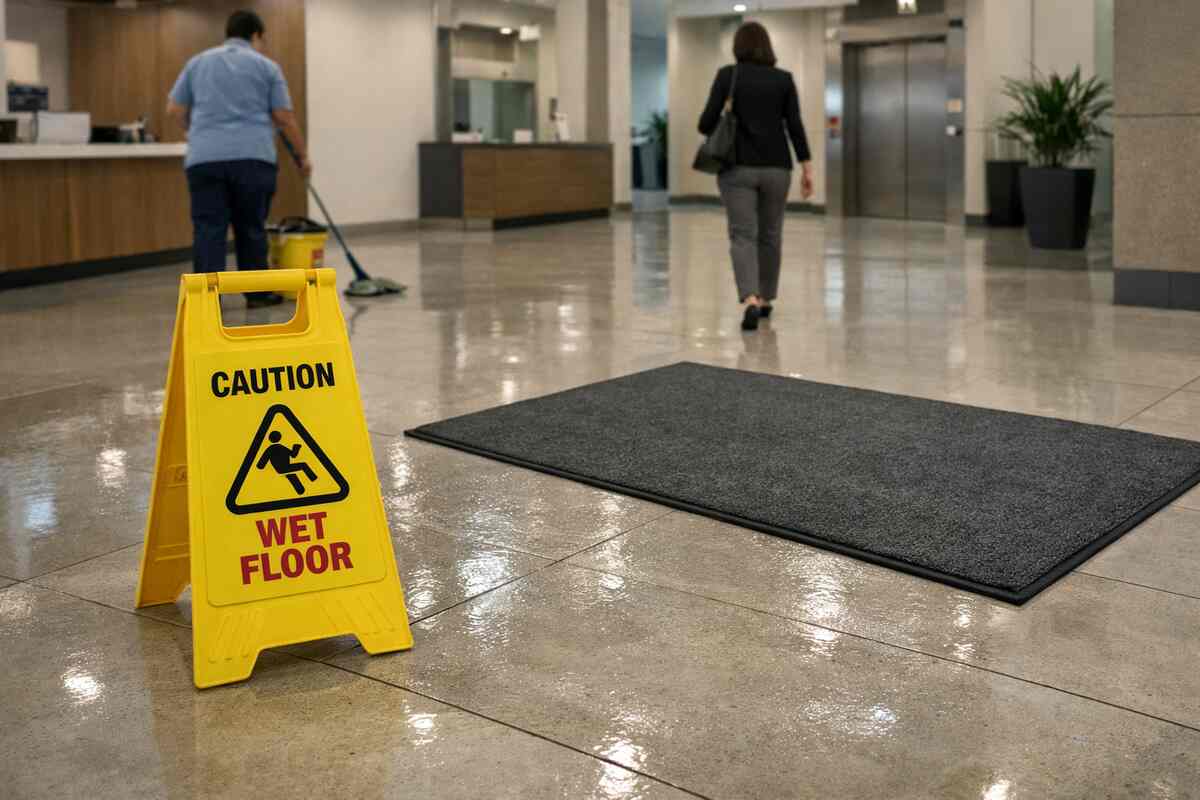
A caution sign doesn’t change the floor. It just warns people after the condition already exists. A mat can help at an entrance, but if it’s undersized or poorly placed, moisture still spreads beyond it. Cleaning more often can improve appearance, but if the process reduces traction, it can make the situation worse.
These are surface-level controls. They respond to symptoms.
What’s usually missing is any verification of whether the walking surface is safe under real conditions. Without that, prevention becomes a series of educated guesses.
That’s why the same issues tend to repeat. The response addresses what’s obvious in the moment, but the underlying performance of the floor never gets evaluated.
There’s also a tendency to apply solutions too quickly. A coating is recommended. A product gets applied. The focus shifts to “fixing” the floor without first understanding whether the floor itself is the problem.
In many cases, it isn’t.
It might be cleaning. It might be moisture control. It might be an inconsistency in how the space is maintained. But without establishing a baseline, those distinctions don’t get made.
Effective prevention starts in a different place. Not with what to apply, but with what to verify.
Until the surface is measured and understood, every decision is based on an assumption. An assumption doesn’t hold up well when something goes wrong.
How to Actually Evaluate Slip Risk (What Professionals Do Differently)
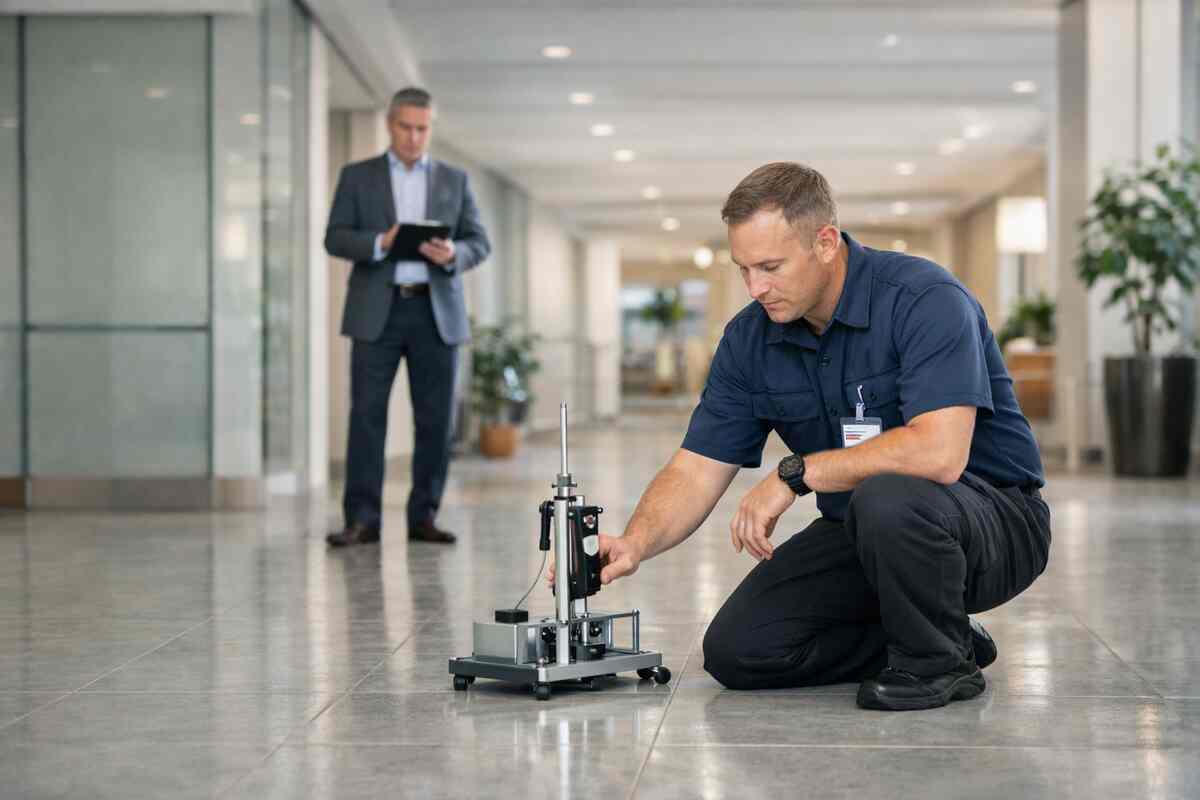
Most facilities try to manage slip risk by reacting to what they can see. The approach that actually works starts by removing that guesswork.
Instead of asking what should be done, the better starting point is understanding how the surface actually performs. Without that, every decision is based on assumption — and assumptions tend to break under the wrong conditions.
Start With a Measured Baseline
The first step is establishing where the floor stands.
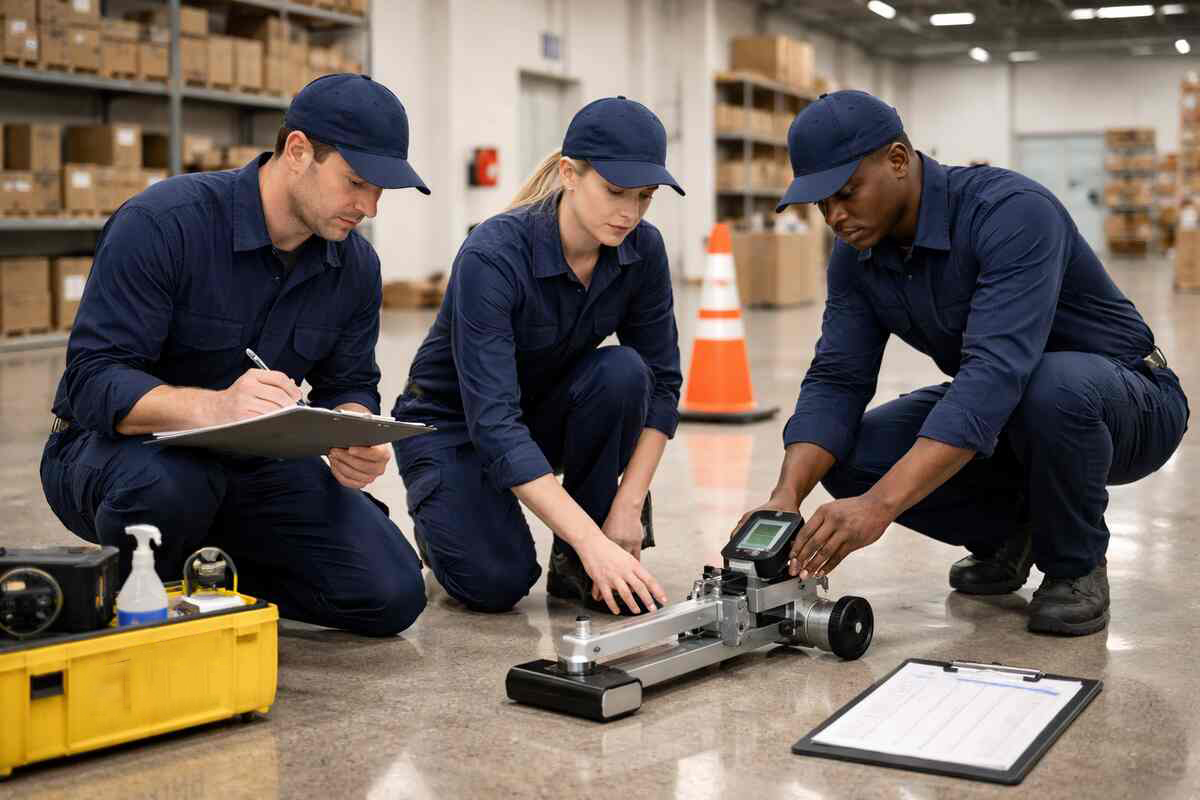
Not how it looks or how it’s expected to behave, but how it performs when it’s tested. This creates a clear baseline that shows whether the surface meets accepted safety thresholds or falls short.
Until that baseline exists, there’s no reliable way to determine whether a condition is truly a problem or just appears to be one.
Separate Surface Issues From System Issues
Once performance is measured, the next step is understanding why something isn’t working.
In many cases, the surface itself isn’t the issue. It’s what’s happening around it:
Cleaning methods that leave residue
Moisture that isn’t being controlled
Traffic patterns that expose certain areas more than others
Without separating these variables, it’s easy to apply the wrong fix. A floor gets treated when the real issue is cleaning, or a product gets applied when the environment is the problem.
Correct the System Before Changing the Floor
After identifying the cause, the focus shifts to correcting the surrounding system.
That might mean adjusting cleaning procedures, improving matting strategy, or standardizing how maintenance is handled across the facility. In many cases, these changes resolve the issue without altering the floor at all.
This approach keeps operations stable and avoids introducing unnecessary changes that create new maintenance concerns.
Intervene Only When It’s Actually Needed
If testing shows the surface doesn’t meet acceptable thresholds, then intervention makes sense — but only to the extent required.
That might involve modifying the surface to improve traction or using a non-slip tile treatment for slippery floors when the material allows for it.
The key is that the decision is based on measured performance, not assumption. The goal isn’t to apply a solution everywhere. It’s to address the specific condition in a controlled, appropriate way.
This kind of approach reflects how in practice — starting with evaluation, then correcting what’s causing the issue, and only changing the surface when it’s necessary.
Common Mistakes That Lead to Repeat Incidents
When slip-and-fall incidents happen more than once in the same facility, it’s usually not bad luck. It’s a pattern.
The initial response often focuses on fixing what’s immediately visible, but the underlying issue remains. Over time, those gaps compound, and the same conditions lead to repeat incidents.
There are a few mistakes that show up consistently.
Assuming “No Incidents” Means “No Risk”
Many facilities operate for years without a reported slip. That creates a sense of confidence that the floors are safe.
But in most cases, the surface was never actually evaluated. It was just never tested under the right conditions at the wrong time.
Slip risk doesn’t disappear because nothing has happened yet. It just hasn’t been exposed.
Treating Symptoms Instead of Causes
After an incident, the response is often immediate:
Add more mats
Increase cleaning frequency
Put up additional signage
These actions address what’s visible, but they don’t answer why the surface failed in the first place.
If the root cause isn’t identified — whether it’s cleaning residue, moisture control, or surface performance — the same issue remains in place.
Skipping Documentation
In many cases, even when adjustments are made, nothing is formally recorded.
There’s no baseline showing how the floor performed before or after changes. No record that the area was evaluated. No documentation that decisions were made based on anything measurable.
That becomes a problem later.
If another incident occurs, the question isn’t just what was done — it’s what can be proven. Without documentation, it’s difficult to show that the risk was assessed ahead of time.
Jumping Straight to Surface Treatments
There’s a tendency to move quickly toward applying a solution — often a coating or treatment — without fully understanding whether it’s necessary.
Sometimes the surface isn’t the problem. It’s the system around it.
Applying a treatment too early can create new issues:
Changes in appearance
Additional maintenance requirements
Inconsistent performance over time
It can also mask the real cause instead of resolving it.
Ignoring the Impact of Cleaning
Cleaning is often treated as a separate function from safety, but in reality, it directly affects how floors perform.
If cleaning methods aren’t evaluated, they can continue to introduce the same issue repeatedly. A surface gets cleaned, traction drops, and the cycle continues.
Many repeat incidents trace back to this pattern.
Allowing Inconsistency Over Time
Even when a facility starts with a solid process, it can drift.
Staff changes. Vendors change. Procedures get adjusted informally. Over time, consistency breaks down, and performance becomes less predictable.
Without a system to verify and standardize what’s happening, small variations turn into real risk.
These mistakes don’t usually happen all at once. They build gradually.
A minor issue gets addressed quickly but not fully. The underlying condition stays in place. Then it shows up again, often under slightly different circumstances.
That’s how isolated incidents turn into repeat exposure.
What Changes When Slip Risk Is Properly Managed
When slip risk is handled the right way, the difference isn’t dramatic on the surface. The floors may look the same. The building still operates the same way.
What changes is what’s known — and what can be proven.
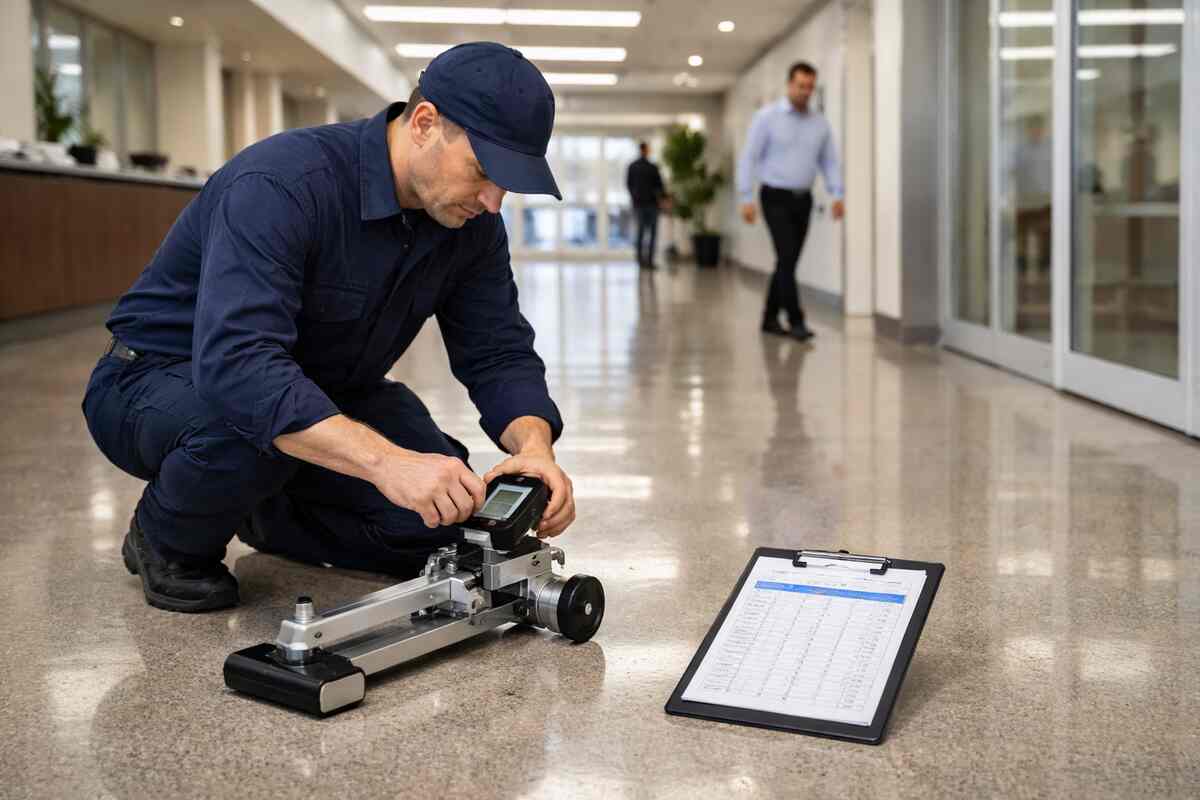
Instead of relying on assumptions, there’s a clear understanding of how each surface performs. There’s a baseline. There are measured results. If conditions change, there’s a reference point to compare against.
That alone removes a lot of uncertainty.
Operations also become more predictable. Cleaning is no longer just about appearance — it’s tied to maintaining performance. Moisture control is intentional. Maintenance follows a consistent process instead of varying from shift to shift.
Nothing feels reactive.
From a management standpoint, the pressure shifts as well. The concern isn’t “What if something happens?” It becomes “We’ve already evaluated this, and we know where it stands.”
That matters, especially in environments where accountability is part of the role.
If an incident does occur, there’s documentation showing the surface was assessed. There’s a record of what was measured, what was found, and what was addressed. That changes how the situation is handled internally and externally.
For many facilities, that’s the real outcome — not just fewer incidents, but a position that’s easier to defend.
It’s a quieter environment. Fewer surprises. Fewer unknowns.
And when questions come up, there’s a straightforward answer:
The surface was evaluated. The conditions were understood. The right steps were taken.
Most Slip-and-Fall Incidents Aren’t Random
Slip-and-fall incidents rarely come out of nowhere. They happen when conditions expose a surface that wasn’t performing as people expected.
That’s the common thread across everything covered here.
It’s not just about wet floors or visible hazards. It’s about how a surface behaves when those conditions show up — and whether that performance has ever been verified.
A floor can look fine and still fall short. A facility can go years without an incident and still carry an unknown risk. Without testing, there’s no clear answer — only assumptions.
Most organizations address this after something happens. That’s when the questions start:
Was the surface ever evaluated?
Was there a known baseline?
Could this have been prevented?
Those questions are much easier to answer when the work has already been done.
If you’re responsible for a facility and you’re not sure how your floors actually perform, the next step isn’t to guess or apply a quick fix. It’s establishing a baseline and understanding where things stand.
If it hasn’t been tested, it’s still an unknown.
If you want to understand how your floors actually perform — before it becomes an issue — call Slip Stoppers of Alabama at 205-473-2925.