
Slip-and-fall risk starts with what you can’t see.
Has this floor ever been tested?
Most slip-and-fall incidents happen on surfaces that looked fine. We measure traction using professional DCOF testing before recommending any changes.
We work with facilities, healthcare, hospitality, and property teams who need traction that will hold up in the real world—and in audit.
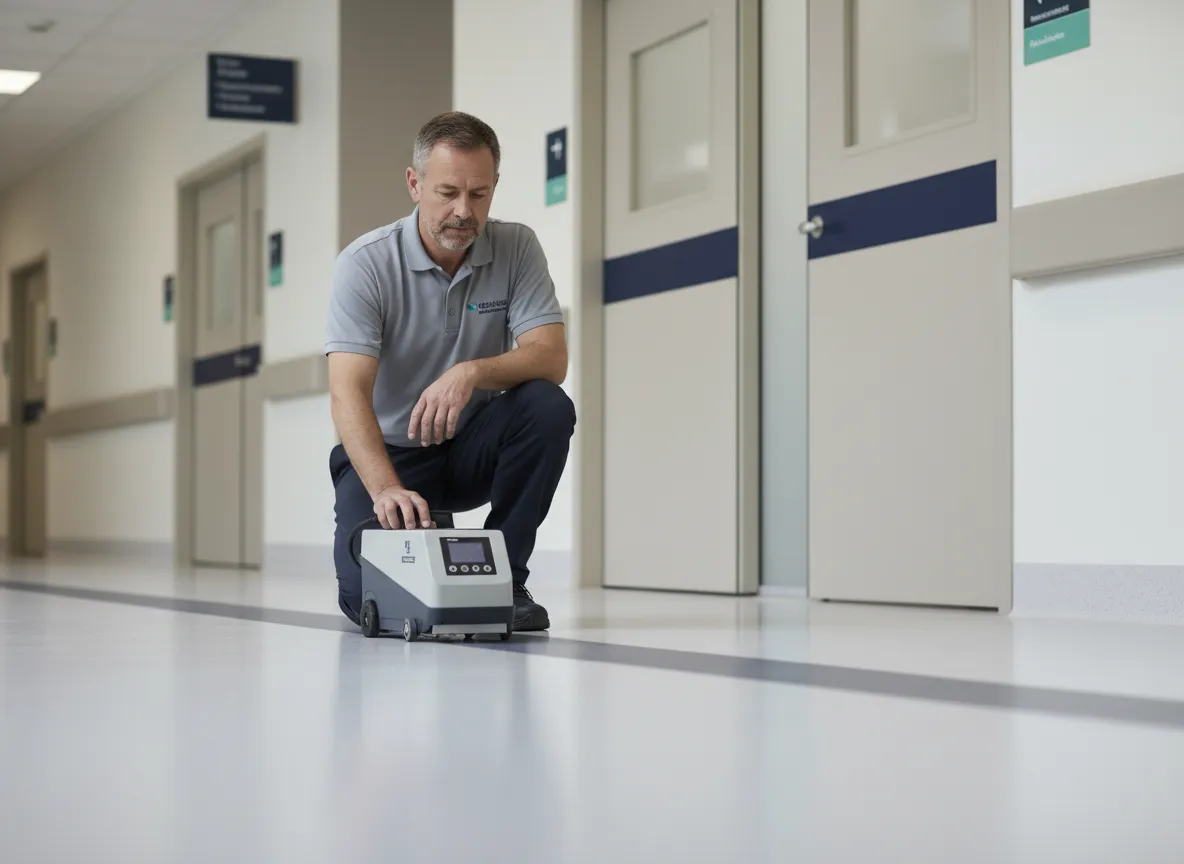
Measurement-First Walkway Evaluation
We test on-site using DCOF instruments and ANSI/NFSI-aligned methods, under the conditions where people actually walk—dry, damp, or fully wet.
- Documented DCOF readings for each test zone
- Clear pass / concern / action labeling
- Recommendations that minimize disruption
It only takes one.
Most organizations only look closely at a floor after an expensive incident. By then, it's too late.
Most floors are never measured. They’re judged by appearance. By feel. By assumption. And most of the time, nothing happens.
Until it does.
A fall could be minor.
It can also mean:
Broken bones
Head injuries
Workers’ compensation claims
Litigation
Insurance scrutiny
Leadership questions
You don’t get to choose which incident becomes serious.
One fall may result in nothing more than a report. Another can lead to a six-figure claim.
Insurance companies and attorneys don’t evaluate based on intent. They look at exposure.
The question isn’t whether a fall will be catastrophic. The question is whether the surface was checked before it happened.
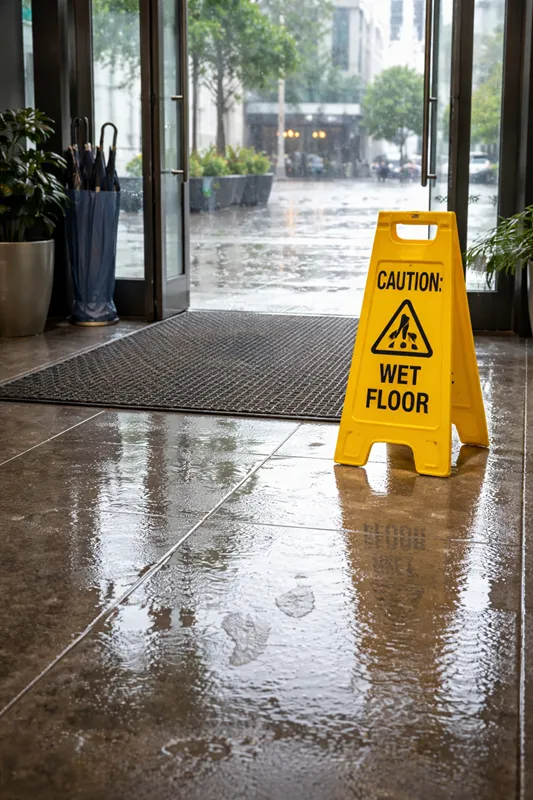
It can look fine and still be a problem.
Slip resistance isn’t about how a floor looks.
It’s about how it performs under real conditions.
We see high-risk areas every week that “look fine” on a walkthrough, but fall short once we put an instrument on the floor.
Traction drops over time:
Cleaning chemistry slowly leaves a residue that reduces traction.
Improper dilution of neutral cleaners or degreasers leaves residue.
Polishes or sealers are added for shine without traction testing.
Moisture tracked in from outdoors or adjacent areas changes surface behavior.
Condensation, steam, or overspray in kitchens and healthcare areas makes areas slippery.
Sanitation cycles affect drip.
Many slip issues start with systems, not surfaces.
If it hasn’t been measured, you don’t actually know how it performs.
We start with testing.
Every engagement begins with professional walkway evaluation. We use Dynamic Coefficient of Friction testing aligned with ANSI/NFSI guidelines. That establishes a measurable baseline.
If the floor meets recognized safety standards, we document it. If it doesn’t, we determine why.
1. Professional walkway testing
We test your floors on site using DCOF measurement equipment, focusing on the zones where people actually slip: transitions, ramps, kitchen paths, lobbies, patient corridors, and more.
2. ANSI/NFSI-aligned evaluation
We interpret the numbers against recognized ANSI and NFSI guidance, so your risk, safety, and legal teams can see how each area compares to accepted traction expectations.
3. Establish a measurable baseline
Each area receives documented DCOF readings and notes about conditions and cleaning practices. This becomes your baseline record for future audits, claims, or changes.
4. Address cause, not just surface
If an area is not where it should be, we look first at systems: cleaning chemistry, dilution, equipment, and scheduling. Surface modification comes next, with coatings only when necessary to achieve compliant traction.
Sometimes the recommendation is: do nothing.
If it meets standards, we leave it alone. There is no benefit in changing a floor that is already performing well.
In those cases, our recommendation may be limited to documentation: keeping the reports on file, training staff on what is working, and setting a schedule to recheck key areas over time.
When intervention is necessary, we prioritize invisible surface modification that improves traction without changing appearance. Coatings are used only when other options cannot achieve safe, compliant results.
What “do nothing” can still include:
- Written confirmation that tested areas met traction expectations on the date of evaluation.
- Notes on cleaning products and procedures that are supporting good performance.
- Simple visual mapping of tested zones for your files.
- Recommendations on when it makes sense to re-test (after renovations, chemistry changes, or schedule changes).
For many facilities, knowing where they are already solid is as important as knowing where to focus improvements.
When something happens, documentation matters.
When a claim is filed, the questions are straightforward: Was the walkway reasonably safe? Did you know about the risk? What did you do about it, and when?
Clear, measured documentation gives your risk, legal, and insurance partners something solid to work with instead of assumptions based on how a floor looks in photos.
Written reports
Each visit includes clear written reports, not just raw instrument outputs. We summarize findings in language your internal teams and insurers can use.
Measured alignment
We connect DCOF readings to applicable ANSI/NFSI guidance, so you can show that your floors were evaluated against recognized traction expectations—not an opinion.
Baseline records and due diligence
Having dated reports on file shows that you identified, measured, and addressed walkway risk. That can make a meaningful difference in claims, audits, and policy reviews.
If a fall occurs, the first question is whether the surface was evaluated. Documentation only protects you if it exists before the incident.
Next step
If it hasn’t been tested, that’s the next step.
You don’t have to assume.
Establish a baseline.
Document the results.
Then decide what’s necessary.
We plan work to limit disruption, communicate clearly with your teams, and leave you with records that support your position if anyone asks, “What did you do about that floor?”
If it hasn’t been tested, it’s still an unknown.
A floor that has never undergone slip resistance testing is an assumption, not a known condition. Our role is to replace assumption with measurement: structured DCOF testing, clear documentation, and practical recommendations only where needed. The priority is clarity over speculation and documentation before intervention.


Professional walkway evaluations aligned with ANSI/NFSI standards. Documentation available for audit, insurance, and risk management review.
Privacy Policy | Terms & Conditions
©2026 Slip Stoppers of Alabama. All rights reserved.
Powered by Kyrios Systems.